Can an email have multiple DKIM signatures?
 ChatGPT
 Claude
 Gemini
 Perplexity
 Grok
GrokIn brief
Can an email have multiple DKIM signatures? Yes. Learn how receivers verify each signature and which passing signature can satisfy DMARC in practice.
Yes. An email can contain multiple DKIM-Signature header fields, signed by the same organization or by different organizations that handled the message. RFC 6376, the DKIM Standards Track specification, says verifiers SHOULD evaluate each signature independently. For DMARC, a passing DKIM signature matters only when its signing domain aligns with the visible From domain, unless aligned SPF supplies the DMARC pass.
At a glance
Quick takeaways
- Multiple DKIM signatures on one email are valid protocol behavior.
- Each DKIM signature has its own
d=signing domain,s=selector, covered headers, and verification result. - A failed DKIM signature does not invalidate another signature that passes.
- A passing provider-owned DKIM signature may not satisfy DMARC alignment for your visible
Fromdomain. - RFC 9989, the current DMARC specification, evaluates a passing DKIM authenticated identifier for alignment with the RFC 5322
Fromdomain. - A delivered message header is the evidence that a production system actually signed a message.
Who is affected?
This applies to any domain that sends mail through more than one service, uses an outbound gateway, participates in mailing lists, or is changing DKIM keys or signing infrastructure. It also applies when an operator opens a message source and sees several DKIM-Signature fields or several dkim= results in an Authentication-Results field.
Multiple DKIM signatures are different from multiple DKIM DNS records. A DNS record publishes one public key for a selector. A DKIM-Signature field in a delivered message shows that a system used a particular selector and signing domain for that message. The email authentication hub explains where DKIM fits with SPF and DMARC.
RFC 6376 permits signatures from the same organization or different organizations involved in handling the message. Common protocol-valid cases include an author domain adding a signature, then a mailing list or intermediary adding another signature. A second signature can also appear while a sender moves traffic to a new signing system.
The standard does not require every message to have more than one signature. It describes how verifiers handle them when they are present.
What are the requirements?
Each DKIM signature is evaluated on its own merits
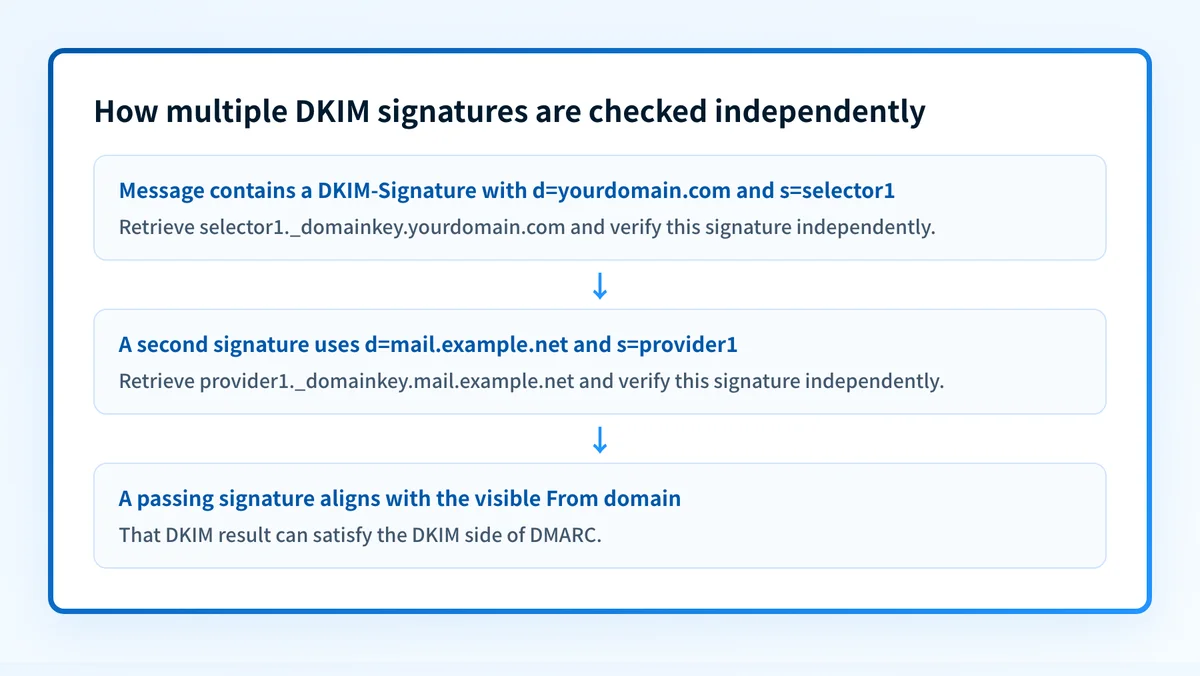
RFC 6376 states that a message can contain signatures from the same or different organizations and that verifiers SHOULD evaluate signatures independently. Each signature refers to its own signing domain through d=, DNS selector through s=, signing algorithm, body hash, and header list.
DKIM-Signature: v=1; a=rsa-sha256; d=yourdomain.com; s=selector1;
 h=from:to:subject:date; bh=example-body-hash; b=example-signature
DKIM-Signature: v=1; a=rsa-sha256; d=mail.example.net; s=provider1;
 h=from:to:subject:date; bh=example-body-hash; b=example-signature
The values above are illustrative only. Do not publish another organization's selector, DNS target, token, or signature value as your configuration.
A verifier retrieves the public key associated with each s= and d= pair, then evaluates that signature's signed headers and body hash. One signature can fail because a later system changed a signed part of the message while another signature still passes.
A passing DKIM signature must align to satisfy the DKIM side of DMARC
RFC 9989 is the current DMARC Proposed Standard and obsoletes RFC 7489. For DKIM evaluation, DMARC compares a passing DKIM authenticated identifier with the RFC 5322 From Author Domain using the domain-alignment rules in the DMARC policy.
This means a message can have several DKIM results with different DMARC value. For example:
- A signature with
d=yourdomain.comcan satisfy the DKIM side of DMARC when it passes and aligns withFrom: alerts@yourdomain.com. - A signature with
d=mail.example.netcan pass DKIM but may not align withyourdomain.com. - A failed aligned signature does not become valid because an unrelated signature passes.
The signature should survive the message path that matters
DKIM verification checks the message as received, not the message as it looked when the first sender submitted it. A later system that changes a signed header, message body, footer, or link can cause one signature to fail.
An extra signature is therefore not automatically a fault. The operational question is whether the intended signature remains valid at the recipient and, when DKIM supports DMARC, whether that signature aligns with the visible From domain.
For a wider security consideration, see DKIM replay attacks: what they are and what controls help. A valid DKIM signature proves that the signed content validated against the published key. It does not, by itself, establish that a later use of a message is authorized.
When does the requirement take effect?
There is no new mailbox-provider deadline for multiple DKIM signatures. The behavior is defined by RFC 6376 and applies whenever a message contains more than one DKIM-Signature field.
RFC 6376 was published as a Standards Track RFC in September 2011. Its rule that verifiers SHOULD evaluate multiple signatures independently is protocol behavior, not a temporary migration rule. RFC 9989 was published in May 2026 as a Proposed Standard and superseded RFC 7489 for DMARC. It defines the current DMARC interpretation of aligned DKIM identifiers.
A provider can make local filtering decisions beyond the protocol minimum. A DKIM pass in a header does not disclose every factor a receiver uses to accept, filter, or place a message.
How do I implement the requirement?
1. Identify the signature that should align with the visible From domain
Choose the system that can sign the final production message using the domain shown in the recipient-facing From header. This can be the sending platform or a final outbound gateway, depending on where intentional message changes occur.
Record the expected d= domain and selector for each production sending path. Do not assume that a platform's generic DKIM status means the delivered message carries an aligned signature.
2. Give independent signing systems separate selectors
Publish a distinct selector and key for each service or signing role. Separate selectors make it possible to identify which system signed a delivered message and to rotate or retire a key without affecting unrelated senders.
The public-key record has this general shape:
selector1._domainkey.yourdomain.com TXT "v=DKIM1; k=rsa; p=example-public-key"This is illustrative only. Generate the actual selector and key in the sending service that owns the private key. Do not reuse another tenant's record value.
3. Place the required signature after planned message modifications
If an outbound gateway adds a footer, rewrites links, or changes covered headers, the aligned signature that must survive delivery should be applied after those deliberate changes. A message can retain earlier signatures, but an earlier signature may fail if its signed content changes later.
Do not remove an existing DKIM signature solely because another one appears. First verify the delivered production message and confirm which signature supplies aligned DMARC authentication.
4. Retire transition signatures after production evidence is available
During a signing migration, keep the old public key available while mail signed with it can still be delivered or verified. Stop adding the old signature only after the new signature appears on the actual sending path and passes verification.
A DNS record can be correctly published while the application still signs with an old selector. Treat DNS publication and delivered-message behavior as separate checks.
How do I validate compliance?
Start with a message delivered through the exact production path. Open its raw source and list every DKIM-Signature field. For each signature, record the d= domain and s= selector, then compare it with the corresponding dkim= result in the message's Authentication-Results field.
Check four layers separately:
- DNS: confirm the expected selector record resolves through the authoritative DNS service and a public resolver.
- Vendor: inspect the sending service's current DKIM or domain-authentication status.
- Message: verify that the delivered message contains the intended signature and that it passes.
- DMARC: once aggregate reports accumulate, confirm that the aligned domain is appearing as expected in DMARC reporting.
For message-level testing, follow the process in How do you test and verify DKIM on a real email?. Compare the delivered message's d= value with the visible From domain and evaluate whether the domains align under the DMARC policy.
Check the DKIM selector behind the delivered signature
After you have identified the d= domain and s= selector in a delivered message, inspect that selector's public DNS record before changing a signing configuration.
A selector check can show the published public key. It cannot prove that the production sender used the key, repair a broken signature, monitor later message changes, or guarantee a receiver's placement decision.
If several systems sign your domains, the ongoing gap is broader than one selector lookup. Palisade is DMARC software that analyzes DMARC aggregate-report data, identifies sending sources and authentication or alignment issues, and creates prioritized remediation tickets. It can propose the next DMARC policy step after a human reviews the evidence and applies the change.
Palisade does not autonomously change your DMARC policy, prove every future message will authenticate, or control a receiver's private delivery decision.
Evidence
Sources and further reading
Questions readers ask
Frequently asked questions
Can an email have two DKIM signatures?
Yes. RFC 6376 permits multiple DKIM-Signature fields on one message. They can come from the same organization or from different organizations that handled the email.
What happens when one DKIM signature passes and another fails?
Each signature is evaluated independently. A failed signature does not invalidate a separate signature that passes, although a receiver can apply its own local filtering policies to the complete message.
Which DKIM signature does DMARC use?
DMARC can use any passing DKIM signature whose signing domain aligns with the visible RFC 5322 From domain. A passing signature from an unrelated provider domain does not satisfy DKIM alignment for your domain.
Can two email services use the same DKIM selector?
Yes, they can technically publish and use the same selector, but separate selectors are safer operationally. Separate selectors make ownership, investigation, rotation, and retirement easier to manage.
Does a passing DKIM signature guarantee inbox placement?
No. A passing DKIM signature validates the signed message content against the published key. It does not guarantee inbox placement, future authentication, or a receiver's private filtering decision.

Written by
Samuel ChenardCEO & Co-Founder, Palisade
Samuel Chenard is the CEO and co-founder of Palisade, agentic DMARC software for IT teams and MSPs, from one domain to thousands.
More from Samuel →