550 message rejected due to senders DMARC policy
 ChatGPT
 Claude
 Gemini
 Perplexity
 Grok
GrokIn brief
550 message rejected due to senders DMARC policy requires the failed message, recipient response, and DNS evidence before a safe repair for your domain.
550 message rejected due to senders dmarc policy is a receiver rejection that needs message and DNS evidence before you change anything. The wording alone does not identify the receiving provider, the exact DMARC evaluation, or whether SPF, DKIM, alignment, forwarding, or a local receiver rule caused the rejection. Preserve the original delivery-status notification and failed-message headers, then compare the RFC 5322.From domain with the authenticated domains.
At a glance
Quick takeaways
- The exact
550text alone does not prove which DMARC condition failed. - Preserve the complete recipient response, enhanced status code, and original message headers before changing DNS.
- Compare the visible From domain with the SPF-authenticated domain and DKIM
d=domain. - Do not relax a DMARC
p=policy as a substitute for finding the failed sending path. - Retest through the same application, sender, route, and recipient provider after an approved repair.
- A public DMARC lookup shows the published record, not the receiver's private decision for one message.
What does the failure mean?
The observable symptom is this rejection text:
550 message rejected due to senders dmarc policyThis wording indicates that the receiving system associated the rejection with the sender's DMARC policy. It does not establish the source of the text, its exact original punctuation, or the rule the receiver applied. In particular, it does not prove that a published _dmarc record is malformed, that the sender used p=reject, or that a specific authentication mechanism failed.
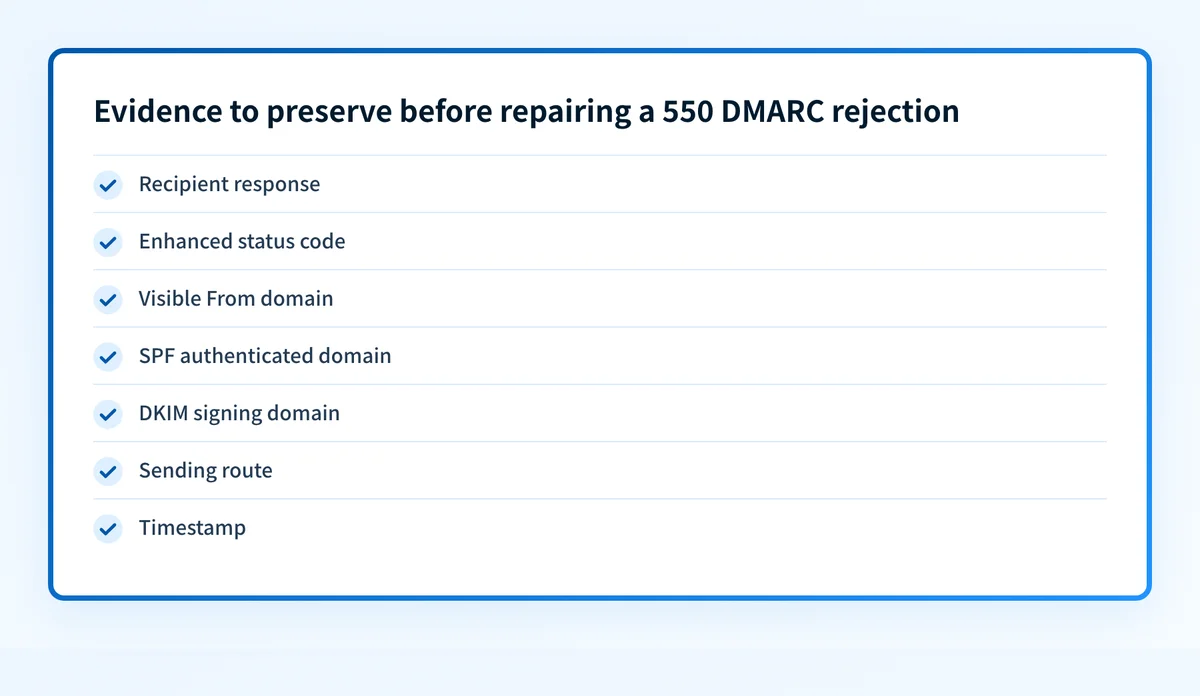
Treat the original non-delivery report or SMTP transcript as the strongest evidence. Preserve the complete response, recipient domain, timestamp, enhanced status code if present, and the full raw source of the rejected message. A generic 550 response can have several causes, as explained in what 550 errors mean. This article addresses only the DMARC-related wording shown above.
The first diagnostic question is narrow: did the rejected message authenticate and align for the visible From domain? Do not infer the answer from a mail client screenshot or a public DNS result.
What usually causes it?
Missing evidence for the actual authentication result
The most likely immediate problem is that the team has the bounce text but not the receiver-added authentication evidence. The available evidence does not document which provider emits this exact string or map it to one failure condition. Without the raw message, an operator cannot distinguish an SPF issue, a DKIM issue, an alignment issue, forwarding, or a receiver-specific decision.
This is an evidence gap, not a reason to edit the DMARC record. Gather the received message source and the original delivery-status notification first.
SPF or DKIM does not support the sending path
Palisade states that it identifies sending sources and pinpoints SPF, DKIM, and DMARC issues behind deliverability problems on its DMARC software page. That supports investigating these mechanisms, but it does not prove which one caused this rejection.
Compare the visible From domain to the domains recorded in the receiver's trusted authentication results. If the receiver reports a failed SPF or DKIM result, record the entire relevant line and the domain values before changing sender configuration.
The authenticated domain does not match the visible From domain
A message can have authentication results without showing that the relevant authenticated domain matches the RFC 5322.From domain. This is an inference to test from the headers, not documented behavior for the unnamed receiver behind this exact error.
Look for the visible From address, the SPF-authenticated domain, and the DKIM signing domain. Keep the findings in one evidence record instead of relying on a provider dashboard alone.
A legitimate sender was not accounted for before enforcement
A staged enforcement process gives operators time to identify legitimate sending sources before moving to stricter handling. Palisade describes the sequence as “monitor, then quarantine, then reject”. The available PowerDMARC page also describes monitoring before moving to p=quarantine/reject on its DMARC implementation guidance.
That guidance does not establish the current record syntax or cause of this rejection. It does support checking whether the affected application, ESP, gateway, or forwarding route was included in the sender inventory before enforcement.
The receiver applied a rule that the available evidence does not disclose
The response may reflect receiver-specific policy, forwarding behavior, or an implementation detail. The available evidence does not document the receiver's evaluation rules, alignment mode, or handling of this exact string. Do not label an inference as a provider rule.
If the message and DNS evidence show authentication and alignment for the production path, collect the provider's own delivery evidence before changing working sender settings.
How do I diagnose the failure?
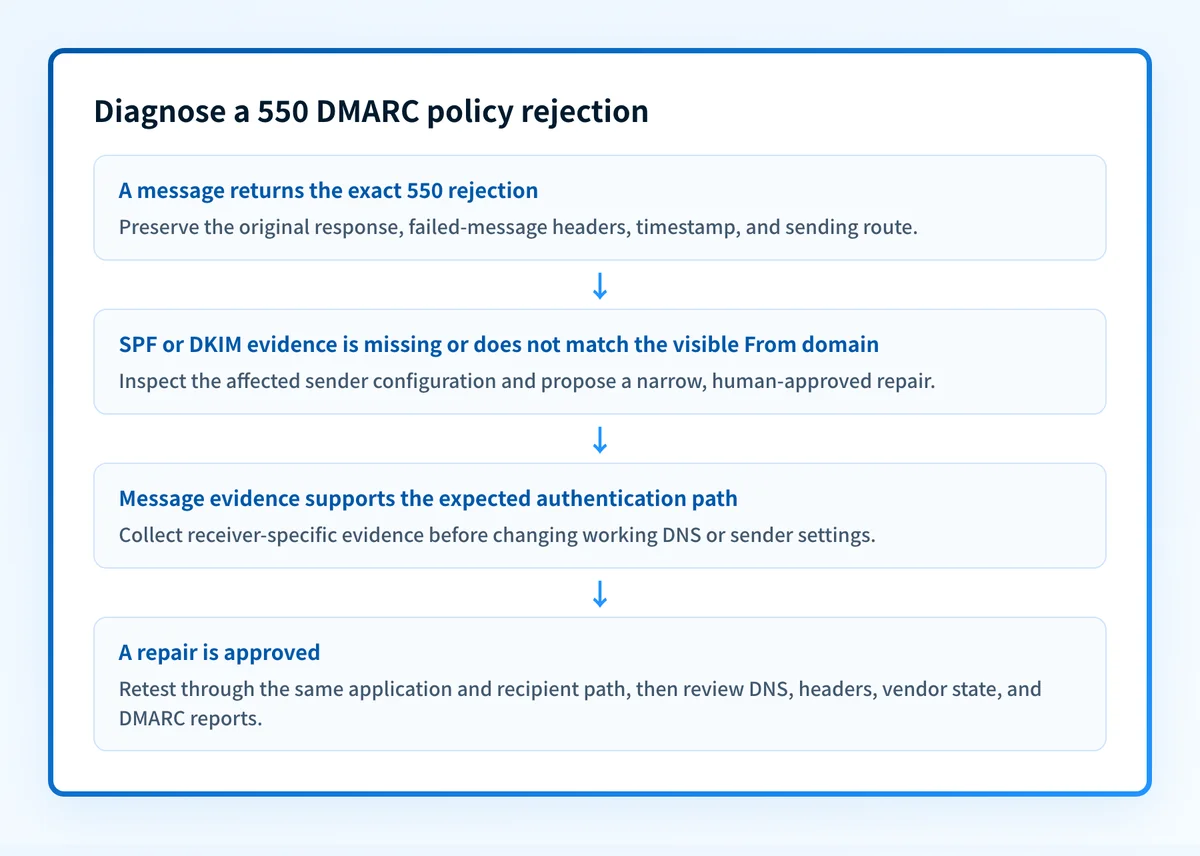
1. Preserve the failed delivery evidence
Save the original delivery-status notification or SMTP transcript without editing the response text. Record the recipient domain, sending application, sending time, Message-ID, and enhanced status code if available.
Obtain the raw source of the original failed message. A forwarded copy, a resend, or a message viewed in a mail client may not preserve the same path or headers.
2. Record the domains from the failed message
From the exact failed message, record these values in a redacted incident note:
Visible From domain: yourdomain.com
SPF authenticated domain: example-mailfrom.yourdomain.com
DKIM signing domain: mail.yourdomain.com
Recipient response: 550 message rejected due to senders dmarc policy
These are illustrative labels only. Do not publish customer addresses, selectors, message identifiers, full headers, private keys, tokens, or recipient data.
The visible From domain is the domain to compare with the authenticated domains. If the receiver's headers do not provide the required SPF or DKIM domains, do not guess from DNS records.
3. Inspect the published DMARC record
Use the DMARC checker to inspect the currently published record for the visible From domain. Capture the result with the incident record and compare it with the message evidence.
A public record check cannot prove why this individual receiver rejected a message, prove the production sender used the intended authentication path, or reveal a receiver's private DMARC decision.
4. Identify the exact sending route
Map the application and every outbound system that handles the affected mail: application, ESP or relay, signing service, gateway, and recipient. Confirm whether the failed message used the same route as a known good message.
The DMARC learning hub provides the wider context for policy and alignment. For this incident, keep the scope limited to the sender and route shown in the failed message.
5. Separate a finding from an inference
A finding is a value visible in the raw message or DNS answer. For example, a DKIM d= value in a header is a finding. A conclusion that a particular receiver rejected mail because of that value is an inference unless the provider documents it or its message evidence says so.
This distinction prevents a risky DNS change based on a generic bounce string.
How do I fix it?
Repair the confirmed sender configuration
If the raw message identifies a failed or non-aligning SPF or DKIM path, repair the configuration for that specific sending application or relay. Keep the change limited to the affected source, and obtain human approval before changing DNS or sender settings.
The repair changes authentication or alignment for that sender. It does not change a receiver's private reputation or guarantee later delivery.
Add the confirmed legitimate sender to the operational inventory
If the affected source is legitimate but was omitted during rollout, document its owner, route, visible From domain, SPF domain, DKIM domain, and validation result. Then apply the narrow sender-side configuration change supported by the message evidence.
Palisade's DMARC enforcement article explains why sender visibility matters before stricter enforcement. Do not treat a sender inventory as proof that every future message will authenticate.
Escalate an unpublished receiver decision with evidence
If the raw message shows the expected authentication and alignment outcome but the rejection persists, provide the recipient provider with the complete response, redacted headers, timestamp, and Message-ID through its supported channel. The available evidence does not establish that a DNS record change will resolve that scenario.
Do not lower p= to work around an unconfirmed sender failure. Policy relaxation changes requested enforcement. It does not repair SPF, DKIM, alignment, routing, or a receiver-specific rule.
Investigate this with your coding agent
Use this after collecting redacted failed-message headers and an exported DNS configuration. The task is to compare evidence and propose a narrow change, not to modify DNS or sender settings.
Agent handoff
Copy the prepared prompt
Give this to a coding agent that can inspect the relevant repository or configuration source of truth.
Problem: A message was rejected with "550 message rejected due to senders dmarc policy" and the failed production path must be compared with the visible From domain.
Evidence: Redacted original-message headers, the recipient response, visible From domain, SPF authenticated domain if present, DKIM d= domain if present, and exported DNS records for yourdomain.com.
Repository scope: DNS infrastructure-as-code, exported DNS record definitions, and mail-sending configuration files for the affected application.
Constraints: Inspect before editing. Do not apply changes until I approve the proposed diff. Exclude secrets, private keys, tokens, unredacted headers, recipient data, and customer data. Identify only the configuration relevant to the confirmed sending path.
Requested output: A diagnosis, minimal proposed change, rollback, and unknowns.
Verification: Send a new message through the same application and recipient path, then compare the trusted authentication results and recipient response with the failed message.
Stop if: Credentials, private data, production mutation, or missing evidence is required.
Human approval required: Review the proposed diff and verification plan before allowing changes. Do not paste secrets, private keys, API tokens, unredacted headers, or customer data.
How do I validate the repair?
Repeat the same sending path. Use the same application, visible From domain, outbound relay or ESP, message type, and recipient provider that produced the rejection. A successful test from another system does not validate the repaired route.
Check the relevant layers independently:
- DNS: confirm the authoritative record and at least one public lookup return the intended published DMARC record.
- Vendor: confirm the sender's own authentication or verification status where that status applies to the affected route.
- Message: inspect a newly delivered message's trusted authentication results and compare its domains with the visible From domain.
- DMARC: once reports accumulate, review whether the affected source continues to show the expected authentication outcome.
Check the published DMARC record after the evidence review
Once you have the visible From domain and the failed message's authentication details, check the DMARC record to inspect what is publicly published for that domain. Compare it with the same-path message evidence before proposing any DNS change.
For an ongoing sender inventory and remediation workflow, Palisade can analyze DMARC aggregate-report data, identify sending sources and authentication or alignment issues, and create prioritized remediation tickets. It can propose the next policy step when the evidence supports it, while a human reviews the evidence and applies the change. It does not change the DMARC policy itself, control a receiver's private rejection decision, or guarantee delivery.
Evidence
Sources and further reading
Questions readers ask
Frequently asked questions
How to fix DMARC policy of reject?
Find the sending path that failed authentication and fix that source, rather than editing the policy. Compare the visible From domain in the rejected message with the SPF-authenticated domain and the DKIM d= domain, then repair whichever one does not align. Change the p= value only when you are deliberately staging enforcement from monitor to quarantine to reject.
How to fix 550 email error?
Start with the full text of the bounce rather than the number, because 550 covers many different recipient decisions. Save the complete response, the receiving provider, the enhanced status code, the raw headers of the failed message, and the exact route that produced it. Then repair only the condition that evidence names, and retest through the same path.
What is 550 DMARC policy?
It is the wording of a rejection message, not a protocol term. The receiving server refused the message and pointed at the sender's DMARC policy as the reason, but the text does not name the provider, the mechanism that failed, or the alignment result. Pull the headers of the failed message before you decide what to change.
Why is my message blocked due to DMARC?
Your message was blocked because the receiver evaluated it under DMARC and it did not pass for the domain in your From address. That happens when neither SPF nor DKIM produced a passing, aligned result for that domain, often because of a forgotten sending service, a relay, or forwarding along the way. The bounce text alone will not tell you which, so read the rejected message's headers.
Should I change DMARC to p=none after this rejection?
No, because loosening the policy hides the problem instead of fixing it. Changing p= only changes what you ask receivers to do with failing mail, and it repairs nothing in your SPF, DKIM, alignment, or routing. Find the production path that failed first.

Written by
Dominic LandryDeliverability & DNS
Dominic Landry works on email deliverability and DNS configuration at Palisade, from SPF and DKIM records through to DMARC enforcement.
More from Dominic →