Which strategy will improve email deliverability?
 ChatGPT
 Claude
 Gemini
 Perplexity
 Grok
GrokIn brief
Which strategy will improve email deliverability? Start by identifying the evidence behind delivery issues, then prioritize the control your team can.
No single strategy can be said to improve email deliverability without evidence from the sending program and the receiving systems involved. The practical strategy is to identify the specific signal first, then change the part of the sending operation that the signal supports. A campaign change may be appropriate for one issue, while domain authentication, message construction, recipient consent, or receiver-specific feedback may be the relevant area for another.
At a glance
Quick takeaways
- Email deliverability is an outcome, not one setting that a sender can switch on.
- A strategy should follow evidence from the actual sending path rather than a generic checklist.
- A public DNS or domain check can inspect published information, but it cannot prove inbox placement.
- A receiver's private placement and filtering decisions remain under that receiver's control.
- A sending team should separate a visible symptom from the evidence needed to explain it.
- A change is easier to assess when the team records what it changed and what result it expects to observe.
How the strategy-selection mechanism works
The question "which strategy will improve email deliverability?" has no reliable universal answer because the desired result is broader than a single technical control. A message can be accepted, filtered, delayed, routed to spam, or placed in an inbox. Those outcomes can differ by receiver, message stream, domain, and time.
For broader context on the term itself, read email deliverability and what email deliverability means. The useful distinction is between an action a sender can take and an outcome a receiver controls.
A sender can collect evidence about its own domain, configuration, message, and sending process. A sender cannot treat one favorable result as proof that every future message will be accepted or placed in the inbox. That boundary matters when selecting a strategy. It keeps a team from changing several variables at once and then attributing an outcome to the wrong one.
A practical strategy therefore begins with a narrow question:
- Is the concern about a specific domain, a particular message stream, or a receiver?
- Is there evidence from the message path, such as a delivery response or a delivered message?
- Is the issue visible only in a public record check, or does it appear in real sending results?
- Does the team have a stable baseline that it can compare after a change?
When the answer changes
The strategy changes when the evidence changes. Do not start by asking which tactic is generally popular. Start by classifying what you know.
Use this decision rule:
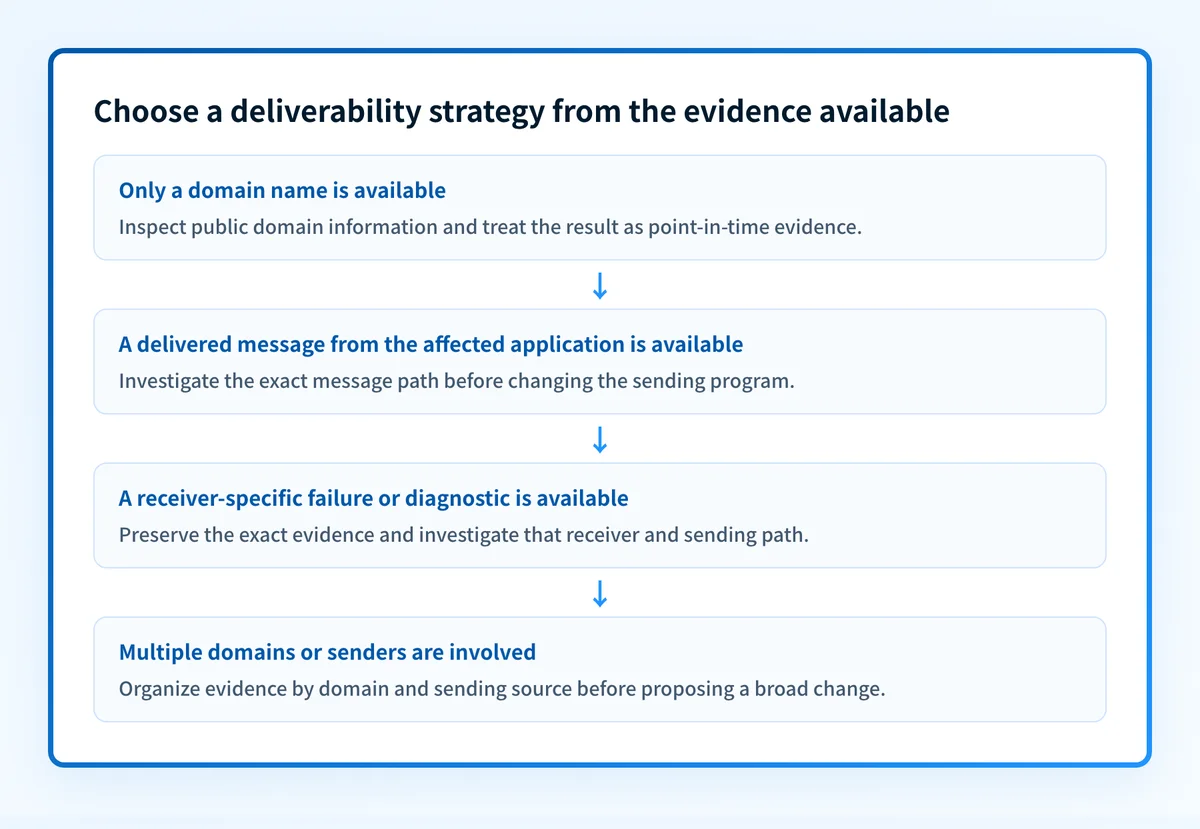
- If the team has only a domain name, inspect the public information associated with that domain. Treat the result as a point-in-time check.
- If the team has a delivered message, use evidence from that exact message path before changing the application, sender identity, or campaign.
- If the team has a delivery failure or receiver-specific notice, retain the exact text and investigate the receiver and sending path involved.
- If the team manages several domains or many legitimate senders, organize the evidence by domain and source before proposing a broad change.
- If the team cannot identify the affected stream or recipient group, gather that context before deciding which strategy to prioritize.
The answer also changes by scope. A one-time public inspection may be useful when a team wants to know what a domain publishes now. It does not show whether the production application used that configuration for a particular message. A delivered message can provide information about one sending event. It does not establish the state of every sender that uses the domain. A receiver's response can be meaningful for that receiver, but it does not establish a universal rule for every mailbox provider.
Do not change several parts of a sending program at once if the team needs to understand which change affected the observed result. Preserve the original evidence and document the intended test first.
For ongoing operational context, the deliverability learning hub groups related guidance by task rather than treating deliverability as a single fix.
Worked evidence example
Consider a team that knows only that messages appear to be performing differently than expected. It should not conclude that a generic campaign adjustment is the correct strategy. The team first needs to describe the evidence it has and the limit of that evidence.
Observed concern: A sending team wants to improve email deliverability.
Evidence available: Public domain information only.
Safe next action: Inspect the domain's current public security posture.
What this can show: A point-in-time public result.
What this cannot show: The production sending path, a receiver's private decision,
or whether future messages will reach the inbox.
Evidence available: A message from the affected application.
Safe next action: Preserve and compare evidence from that exact path.
What this can show: Information about that sending event.
What this cannot show: The state of every other sender using the domain.
Evidence available: A receiver-specific failure or diagnostic.
Safe next action: Investigate the receiver and exact sending path involved.
What this can show: Evidence relevant to that receiver and event.
What this cannot show: A universal placement rule.
The strategy in each case is different because the evidence object is different. The first case calls for an inspection. The second calls for message-path analysis. The third calls for receiver-specific investigation. None of those cases supports a blanket claim that a single change will improve all mail.
This approach also helps during periods of higher sending activity. A peak period may increase the urgency of an issue, but urgency does not identify the cause. Keep the affected stream, timing, recipient population, and observed result together. That record lets the team compare later results with the original concern instead of relying on memory.
Take the next practical step from the evidence you have
If you have only a domain and need a starting point, use the Email Security Score tool to inspect the domain. Use the result as one input to a wider investigation, then compare it with evidence from the production sending path before changing a campaign or configuration.
If you already have an affected message or receiver response, begin with that evidence instead. A public score cannot replace raw message evidence or explain a private mailbox-provider placement decision.
For teams responsible for multiple domains or a growing sender inventory, the unresolved problem is ongoing visibility: a point-in-time check does not identify every legitimate source or show which production paths continue to have authentication or alignment issues. Palisade is AI-first, agent-first DMARC software that analyzes DMARC aggregate-report data, identifies sending sources and authentication or alignment issues, and creates prioritized remediation tickets. It can propose the next DMARC policy step when the evidence supports it, while a human reviews the evidence and applies any change.
Palisade does not control a receiver's private reputation or placement decision, guarantee delivery or inbox placement, or prove that every future message will authenticate.
Evidence
Sources and further reading
Questions readers ask
Frequently asked questions

Written by
Samuel ChenardCEO & Co-Founder, Palisade
Samuel Chenard is the CEO and co-founder of Palisade, AI-first DMARC software for IT teams and MSPs, from one domain to thousands.
More from Samuel →