Does a subdomain need its own SPF record?
 ChatGPT
 Claude
 Gemini
 Perplexity
 Grok
GrokIn brief
Does a subdomain need its own SPF record? Yes, when it is the MAIL FROM or HELO domain SPF evaluates. Learn how to verify the exact identity.
Yes, a subdomain needs its own SPF record when a sending system uses that subdomain as its MAIL FROM identity, or as its HELO identity when the reverse path is empty. SPF checks the exact SMTP identity presented by the message. A parent-domain SPF record does not automatically apply to a subdomain. A visible From address on a subdomain alone does not determine where SPF looks.
At a glance
Quick takeaways
- SPF evaluates the MAIL FROM domain when available, then the HELO domain for a null reverse path.
- SPF does not inherit a parent domain's DNS policy at a subdomain.
- A subdomain used only in the visible From address may not need its own SPF record.
- Each active SPF identity needs one valid SPF record at its exact DNS name.
- DMARC relaxed alignment can accept related domains only after SPF passes.
- Delivered-message headers show the identity SPF actually evaluated.
How SPF selects a subdomain record
RFC 7208 defines the SPF evaluation identity: a receiver normally evaluates the domain in the SMTP MAIL FROM command. If the message has a null reverse path, the receiver evaluates the HELO or EHLO domain instead. It then retrieves SPF policy for that identity's domain.
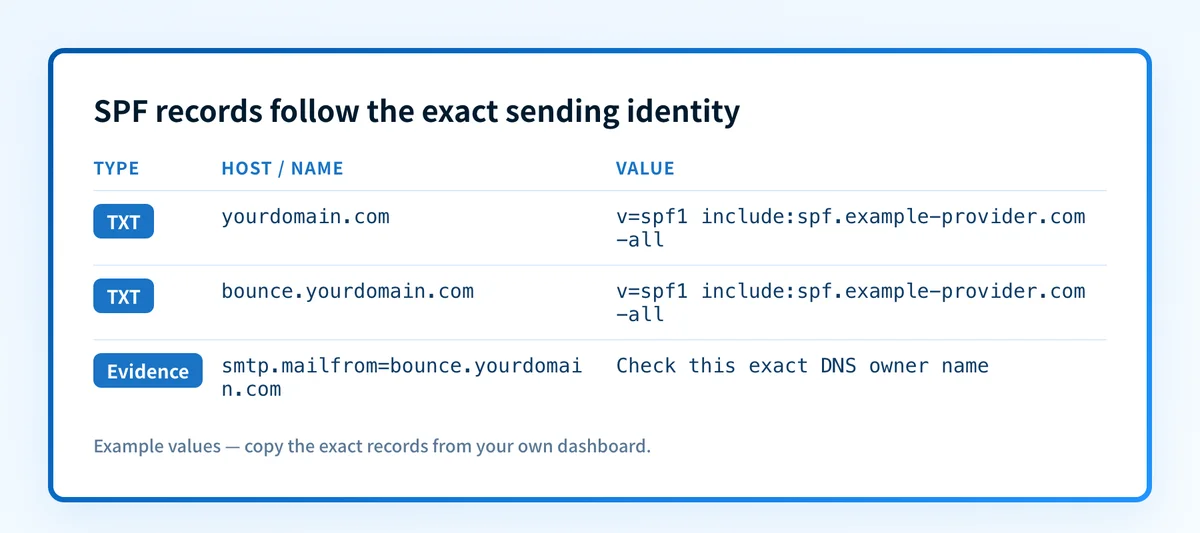
For example, if a marketing platform sends with bounce.news.yourdomain.com as MAIL FROM, SPF looks for a TXT record at bounce.news.yourdomain.com. It does not look at yourdomain.com and extend that policy downward.
If no SPF record exists at the evaluated subdomain, the SPF result is none. The presence of a valid record at the parent does not change that result. RFC 7208 also says a domain must not publish multiple SPF records that cause multiple applicable records to be selected.
The visible From address has a separate role. A message can show From: updates@news.yourdomain.com while using bounce.yourdomain.com in MAIL FROM. SPF checks the latter identity. DMARC later compares an authenticated SPF identity with the visible From domain. For the wider protocol context, see Palisade's email authentication learning center.
When a subdomain needs a separate SPF record
Use this decision rule for each production sending path:
- If the subdomain appears as the actual MAIL FROM domain, publish and maintain SPF at that exact subdomain.
- If a message has an empty MAIL FROM and the subdomain appears in HELO or EHLO, publish and maintain SPF at that HELO domain.
- If the subdomain appears only in the visible From address, inspect the delivered message before adding SPF. The SPF identity may be different.
- If the subdomain never appears as an SPF identity, a parent SPF record still does not cover it, but the subdomain may not need a sending authorization record.
A common example is a transactional sender that uses mail.yourdomain.com in the visible From address but a provider-managed return path under bounce.yourdomain.com. The relevant SPF record is the one at bounce.yourdomain.com, provided that is the MAIL FROM identity shown in the delivered message. Do not add an SPF record to mail.yourdomain.com based only on the visible From address.
Do not replace an existing SPF TXT record by adding a second one. Consolidate authorized mechanisms into the single SPF policy for that exact owner name, then verify the sending path before removing any existing authorization.
Worked SPF record example
The following is illustrative only. Do not publish this record unchanged. Use the sending provider's generated authorization values and confirm which MAIL FROM or HELO identity its production messages use.
bounce.yourdomain.com. IN TXT "v=spf1 include:spf.example-provider.com -all"This example authorizes the provider named by the include mechanism to send mail using bounce.yourdomain.com as the evaluated SPF identity. It does not authorize the same provider for yourdomain.com, news.yourdomain.com, or any other sibling name.
A practical evidence object starts with the delivered message. Look for fields such as:
Return-Path: <bounces@bounce.yourdomain.com>
Authentication-Results: recipient.example;
    spf=pass smtp.mailfrom=bounce.yourdomain.com
The Authentication-Results header is generated by the receiving system and can show the SPF result and evaluated identity. RFC 8601 specifies the Authentication-Results header field. Header formatting and available properties can vary by receiver, so use the delivered message from the exact production route rather than copying a header from another sender.
Verify the subdomain by the evidence you have
If you have a delivered message, inspect its Return-Path and authentication results first. Record the smtp.mailfrom value when present. That is the strongest starting point for deciding which DNS name needs an SPF policy.
If you have DNS access but no message evidence, list each sending platform and ask which custom return-path, envelope sender, or HELO identity it uses. A provider's configuration screen can show an intended identity, but it does not prove that the production message uses it.
Then validate at four layers:
- Query authoritative DNS and at least one public resolver for the exact evaluated domain, such as
bounce.yourdomain.com. - Confirm the sending provider reports its authenticated domain or custom return path as verified, where that provider exposes a status.
- Send a real message through that platform and inspect the resulting headers for an SPF pass at the expected identity.
- Review DMARC aggregate reports after they accumulate to find sources or alignment failures that a single test message missed.
If the evidence shows that SPF passes but DMARC fails, compare the SPF-authenticated domain with the visible From domain and review DKIM setup for subdomains. DKIM can provide the aligned authentication result for a path where SPF uses a different domain. For a broader inventory of mail-related DNS records, see what DNS records a business email domain needs.
Check the SPF record for the sending subdomain
Start by checking the exact subdomain found in the delivered message, such as bounce.yourdomain.com. Compare the public SPF record with the identity the provider and production headers show.
Check the subdomain's SPF record
A DNS check cannot prove that every production sender uses the checked subdomain, repair a failed sending path, or show a receiver's future placement decision.
When multiple domains or sending sources need ongoing review, Palisade is agentic DMARC software that analyzes DMARC aggregate-report data, identifies sending sources and authentication or alignment issues, and creates prioritized remediation tickets. It can propose the next DMARC policy step for human review, but it does not change the DMARC policy or guarantee delivery.
Compare the parent and sending subdomain without guessing
The SPF record to inspect belongs to the identity the receiver evaluated. This illustrative message uses different visible From and envelope-sender domains:
From: Updates <updates@news.example.com>
Return-Path: <bounces@bounce.example.com>
Authentication-Results: receiver.example;
    spf=none smtp.mailfrom=bounce.example.com
Use authentication results added by a receiving system you trust. A copied or untrusted header is not independent proof. Here, the recorded SPF identity is bounce.example.com, so checking only example.com or news.example.com would answer the wrong question. RFC 7208 defines the MAIL FROM identity used for this check.
dig TXT example.com +short
dig TXT bounce.example.com +short| Evidence | What to do next |
|---|---|
| Parent has SPF; evaluated subdomain has none | Confirm the provider's current custom return-path setup and required DNS record type before changing the exact subdomain |
| Evaluated subdomain already has an SPF policy | Compare the existing authorization with the sender; do not add a second SPF policy |
| Message passes SPF at a provider-owned domain | Check the visible From alignment separately; a new record at your parent domain does not change that message's SPF identity |
These example domains are not deployment values. Start with the SPF checker for the exact evaluated domain, and use the email header analyzer to inspect the message evidence. Preserve a provider-required CNAME delegation instead of adding a conflicting TXT record at that name.
Investigate the sending identity with Palisade MCP
Palisade MCP can help compare available authentication evidence and explain the next check. Follow the MCP setup guide, then replace the placeholders with identities from the same sending route. Keep private message content out of the prompt.
Palisade MCP
Fix this with Palisade MCP
Connect Palisade to your assistant, then copy this prompt to investigate the findings and review a proposed fix.
View the prepared prompt
Investigate SPF for visible From domain [domain] and the actual MAIL FROM domain [domain], using Palisade's available tools. If the reverse path is empty, ask for the HELO identity instead. Read live DNS for the evaluated identity where supported and review available monitored-domain reports and matching tasks. Do not assume parent-domain SPF is inherited or that the visible From domain is the SPF identity. Ask for the provider's current return-path instructions before proposing a record; preserve any required CNAME delegation and all verified legitimate senders. Present the evidence, uncertainties and proposed change for my approval. Recheck DNS after approved publication and require a new message test before claiming SPF or DMARC passes.Set up Palisade MCP · See the worked example
Review changes before publication. External DNS publishing uses approved DNS access or Smart DNS Deployment in the Palisade app. After DNS verification, test the same sending stream.
Questions readers ask
Frequently asked questions
Does a visible From subdomain need its own SPF record?
No. SPF normally evaluates the MAIL FROM domain, not the visible From domain. Check a delivered message's Return-Path and authentication results before deciding where an SPF record belongs.
Can two subdomains use the same SPF policy content?
Yes. They can contain similar or identical mechanisms when the same services are authorized to send using each identity. Each subdomain still needs its own single SPF record.
Does relaxed DMARC alignment remove the need for SPF on a sending subdomain?
No. Relaxed alignment applies after SPF has passed. The receiver must first find and evaluate SPF policy for the actual MAIL FROM or HELO identity.
What if a subdomain has no SPF record?
If SPF evaluates that subdomain and finds no policy, the SPF result is none. A parent-domain SPF record does not supply a fallback policy for the missing subdomain record.

Written by
Dominic LandryDeliverability & DNS
Dominic Landry works on email deliverability and DNS configuration at Palisade, from SPF and DKIM records through to DMARC enforcement.
More from Dominic →