Which email security stories mattered in April 2022?
 ChatGPT
 Claude
 Gemini
 Perplexity
 Grok
GrokIn brief
Welcome back to our weekly security roundup. This week’s focus is on three major email-related incidents that could impact your organization’s defenses.
Welcome back to our weekly security roundup. This week’s focus is on three major email-related incidents that could impact your organization’s defenses.
At a glance
Quick Takeaways
- U.S. agencies warned about new malicious cyber tools targeting energy infrastructure.
- Hafnium group leveraged a Windows bug to hide scheduled tasks, extending persistence.
- Fox News exposed ~13 million records due to misconfigured cloud storage.
- These incidents highlight the need for robust email authentication (DMARC, DKIM, SPF).
- Regularly audit cloud permissions and monitor for hidden scheduled tasks.
What new malicious cyber tools are targeting North American energy systems?
U.S. agencies, including the FBI and CISA, issued an alert about previously unknown tools that could give attackers full control over industrial control systems. While attribution remains unclear, some analysts suspect Russian involvement based on past activity. The tools are designed to exploit vulnerabilities in energy sector networks, making them a high-risk vector for sabotage. Organizations should prioritize network segmentation and monitor for unusual command-and-control traffic. Strengthening email authentication can also reduce phishing attempts that deliver such tools.
How does the Tarrask malware hide scheduled tasks on Windows?
The state-sponsored Hafnium group introduced Tarrask, which creates hidden scheduled tasks by stripping the Security Descriptor from the task registry entry. This makes the tasks invisible to standard tools like schtasks /query and the Task Scheduler UI. Even after a system reboot, the malicious tasks persist, allowing continued access. Detecting Tarrask requires checking the registry for tasks lacking a security descriptor. Applying the latest Windows patches and using endpoint detection tools can mitigate this threat.
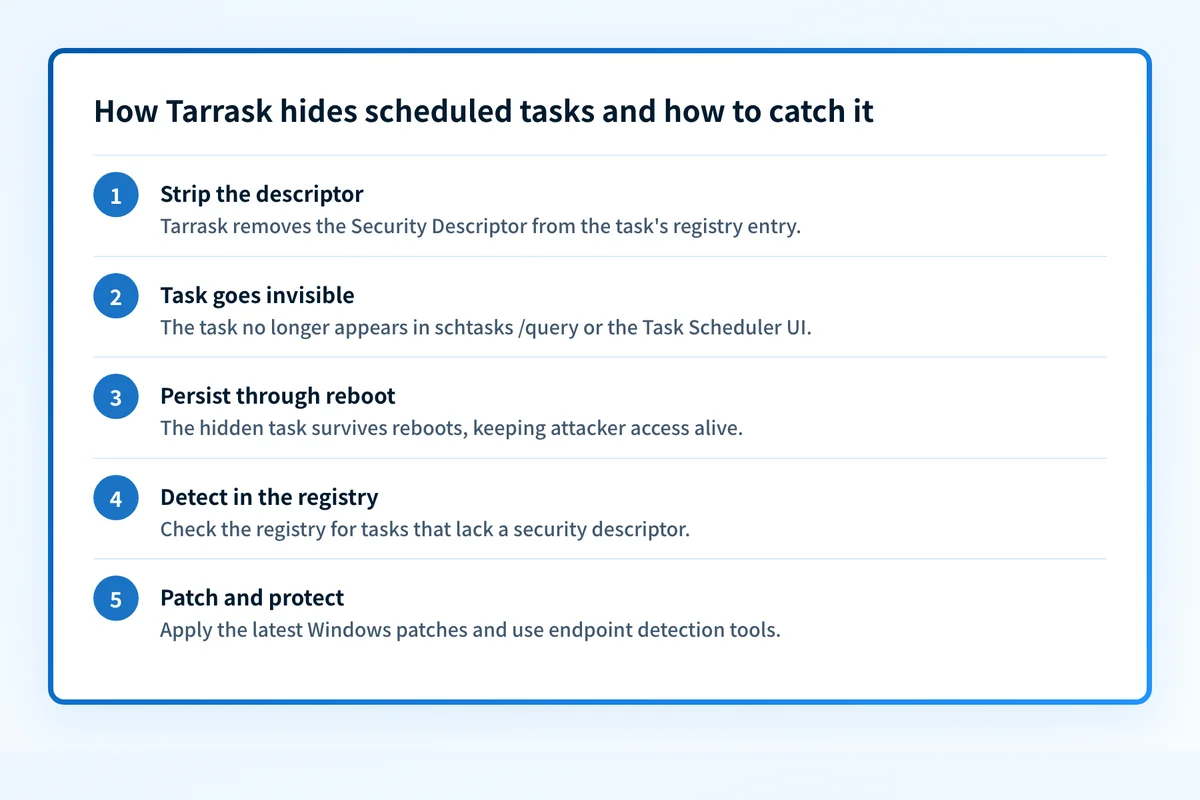 Tarrask strips the Security Descriptor so tasks vanish from standard tools.
What was exposed in the Fox News data leak?
A misconfigured cloud bucket left 58 GB of data publicly accessible, revealing personal information for roughly 13 million individuals, including celebrities, internal staff, and technical details. Exposed data ranged from email addresses and employee IDs to hostnames and IP addresses. The breach underscores the importance of proper cloud storage permissions and regular audits. Affected parties should monitor for credential misuse and consider password changes. Implementing strict access controls can prevent similar leaks.
Why is email authentication critical after these incidents?
All three incidents could be amplified through phishing emails that bypass weak authentication. Implementing DMARC, DKIM, and SPF helps verify legitimate senders and blocks spoofed messages. Palisade’s Email Security Score can quickly assess your domain’s protection level. Check your email security score now to identify gaps and improve defenses.
What steps can organizations take to improve overall email security?
Start by deploying DMARC, DKIM, and SPF with strict policies and monitor reports for anomalies. Conduct regular cloud permission reviews to ensure no public buckets expose sensitive data. Use endpoint detection and response (EDR) tools to spot hidden scheduled tasks or unusual processes. Train staff on phishing awareness, especially regarding unexpected attachments or links. Finally, stay informed on emerging threats through trusted security newsletters.
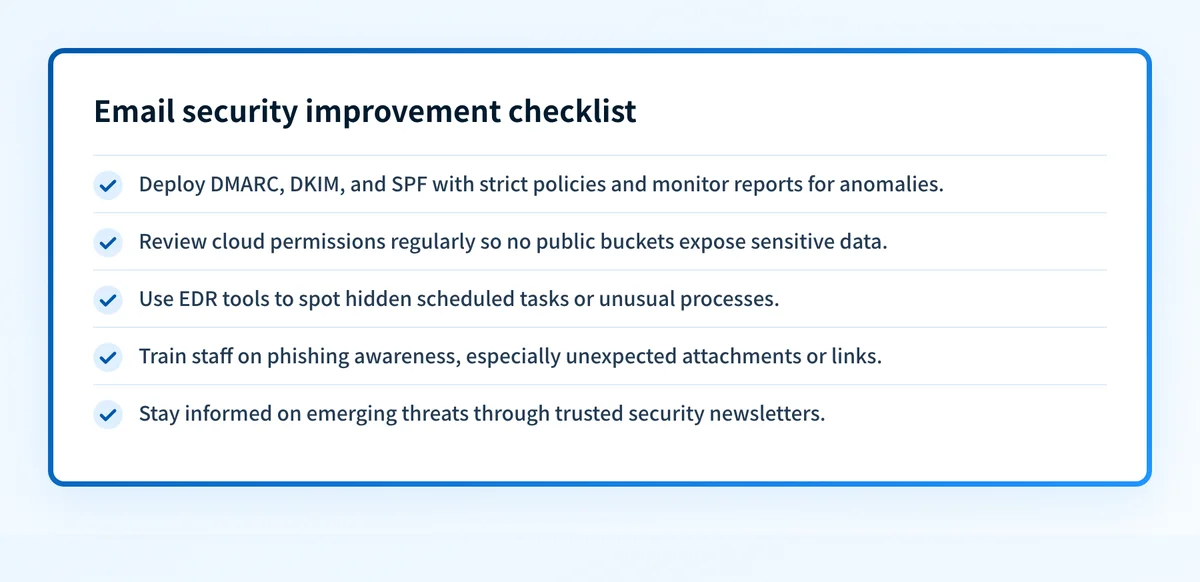 Five steps to strengthen email and cloud defenses.
Questions readers ask
FAQs

Written by
Taylor TabusaCo-Founder & Head of Business Development, Palisade
Taylor Tabusa is the co-founder and Head of Business Development at Palisade, helping managed service providers turn email security into a practical, valuable service.
More from Taylor →