New Deadline: 7 Days Left to get your Emails in line with Google
Just 7 days left for mass senders fix their DNS
Google has announced new authentication requirements for email senders effective from October 2023. This change could lead to the rejection and bounce-back of numerous emails sent to Gmail accounts.
 According to the Google blog, email senders will be required to authenticate their messages, provide straightforward means for subscription cancellations, and stay below a certain spam report threshold.
These changes primarily focus on ensuring that senders authenticate their emails, offer easy unsubscription, and limit spam complaints below a certain level.
In just one week, Google will enforce these new standards for many email senders. This signals a need for organizations to review and improve their email sending practices immediately. Compliance with these standards is essential to avoid email rejection, which could affect communication channels with millions of users.
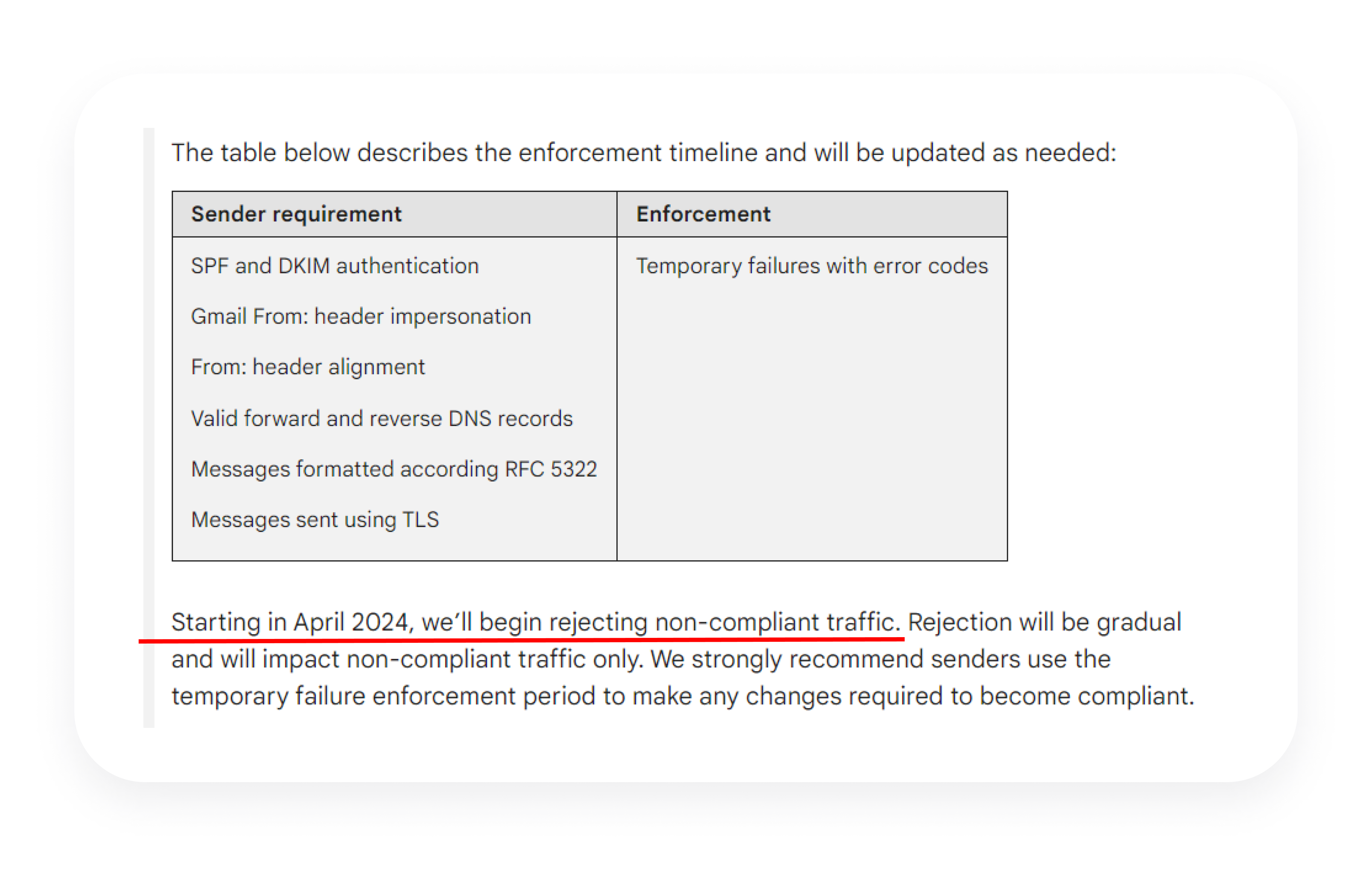
Here’s the breakdown of what will be enforced in April.
- SPF and DKIM authentication
- Gmail From: header impersonation
- From: header alignment
- Valid forward and reverse DNS records
- Messages formatted according to RFC 5322
- Messages sent using TLS
Google's internal data showcases how its AI effectively filters out over 99.9% of spam, phishing attempts, and emails harboring malware from user inboxes, blocking about 15 billion emails daily.
So, the question arises—why introduce these new regulations? Despite these impressive statistics, a number of harmful or undesired emails still manage to evade detection. And Google (and other ESPs) would like to fix that.
The Importance of Compliance and the Risk of Non-Action
Stricter Regulations for Bulk Email Dispatchers
The focus of these regulations is on "bulk senders"—defined by Google as entities sending at least 5,000 emails daily to Gmail addresses.
Once you send 5000 emails in a single 24-hour period, you will be classified as a bulk sender permanently.
Though Google's approach to implementing these rules seems gradual, expect enforcement to intensify starting April 1st, 2024. "From April 2024, we will start to decline non-compliant email traffic," Google warns in its FAQ on email sender guidelines, urging senders to use the lead-up period for necessary adjustments to comply.
You will begin to see non-deliveries and temporary failures with error codes to help you diagnose the issues. While Google's phased approach provides a buffer for organizations to become compliant, the window for action is narrowing.
This initiative underscores the importance of familiarizing oneself with and implementing email security protocols such as DMARC, DKIM, and SPF. Not only do these protocols fortify sender-side security, but they also ensure emails reach their intended recipients, reducing the risk of spoofing and hijacking by malicious actors.
Moreover, starting June 1, Google will mandate that all commercial and promotional emails include a one-click unsubscribe function, emphasizing user control and consent in email communications. This upcoming requirement further illustrates the evolving email landscape and the growing emphasis on user security and convenience.
It's crucial to note that these requirements apply universally to all senders, including those utilizing Google Workspace for their email campaigns.
We can save you time and money.
Email deliverability is a technical topic that you shouldn’t have to learn. Your time is expensive and is better used elsewhere. (We know, that’s why were are building a product to automate this!) Let us take care of the boring stuff. Do you really want to check all these every time, or would you rather offload this and then spend your time building your company and increasing your revenue.
Check your compliance with Palisade’s tools here.
Related reading

Written by
Samuel ChenardCEO & Co-Founder, Palisade
Samuel Chenard is the CEO and co-founder of Palisade, the DMARC automation platform for MSPs. He writes Palisade's guides on DMARC, SPF, DKIM and email deliverability.
More from Samuel →