Email Security Threats and Statistics 2025
 ChatGPT
 Claude
 Gemini
 Perplexity
 Grok
GrokIn brief
2025 email threats are rising. Learn how phishing works, what Microsoft's DMARC rules require, and how to check your own domain's authentication.
Introduction to Email Security Threats
Email remains a prime target for cybercriminals, with 2025 set to see even more sophisticated attacks. Phishing, spoofing, and AI-driven scams are surging, costing businesses millions and hurting their credibility. The stats below show why this matters. Without a proper DMARC setup, your emails could be hijacked, landing in spam or worse, used to scam your own customers.
Below is a table summarizing key statistics in cybersecurity from 2024 that highlight the urgency for better security measures:
/ Table Container for responsiveness / .table-container { width: 100%; overflow-x: auto; margin: 20px 0; }
/ Table Styling / .threat-table { width: 100%; border-collapse: separate; border-spacing: 0; font-family: Arial, sans-serif; background-color: #ffffff; border: 1px solid #E5E7EB; border-radius: 10px; }
/ Table Header / .threat-table th { color: #0E7BFF; padding: 12px; text-align: left; font-weight: bold; border-bottom: 1px solid #E5E7EB; }
/ Table Cells / .threat-table td { padding: 12px; border-bottom: 1px solid #E5E7EB; }
/ Vertical lines between columns / .threat-table th:not(:last-child), .threat-table td:not(:last-child) { border-right: 1px solid #E5E7EB; }
/ Remove border from last row / .threat-table tr:last-child td { border-bottom: none; }
/ Ensure rounded corners for top and bottom cells / .threat-table th:first-child, .threat-table td:first-child { border-left: none; } .threat-table th:last-child, .threat-table td:last-child { border-right: none; } .threat-table tr:first-child th:first-child { border-top-left-radius: 10px; } .threat-table tr:first-child th:last-child { border-top-right-radius: 10px; } .threat-table tr:last-child td:first-child { border-bottom-left-radius: 10px; } .threat-table tr:last-child td:last-child { border-bottom-right-radius: 10px; }
/ Responsive Design / @media screen and (max-width: 600px) { .threat-table th, .threat-table td { font-size: 14px; padding: 8px; } }
Threat Statistics (2024) Why It Matters Phishing Surge 28% increase in phishing emails from Q1 to Q2 Scams hit harder, fooling more users daily Companies Hit 94% of businesses were targeted by phishing attempts Almost every company’s at risk without defenses AI-Driven Scams 67.4% of phishing attacks utilized AI AI makes scams sneakier, and it’s growing fast QR Code Scams 10.8% of phishing used QR codes Expected to rise, bypassing traditional SEGs Multi-Channel Attacks 30.8% of scams used Teams as a follow-up Scams spread beyond email, needing broader protection Email Fraud Losses Nearly $84 million in losses, averaging over $55,000 per incident One scam can crush your budget or reputation Spam Flood 90% of emails were spam or scams Spam floods inboxes, masking scams that slip through
How the Industry’s Tackling The Problem
In 2024, Google and Yahoo led the charge against phishing and spoofing, rolling out strict SPF, DKIM, and DMARC requirements to protect inboxes. Now, Microsoft Outlook is following up with new requirements that will start in May 2025, mandating these protocols for high-volume senders (over 5,000 emails daily). Non-compliant companies face hitting the spam folders more often or not getting their emails delivered at all. The message from these industry giants is clear: robust authentication is now mandatory to keep your emails secure and delivered in 2025.
How Palisade fits
Palisade is agentic DMARC software for IT teams and MSPs, from one domain to thousands. Its DMARC agent investigates sending sources, works through SPF and DKIM alignment, and proposes each policy step toward p=reject for your approval. Provider requirements still need to be checked against the sender type and the provider's current documentation.
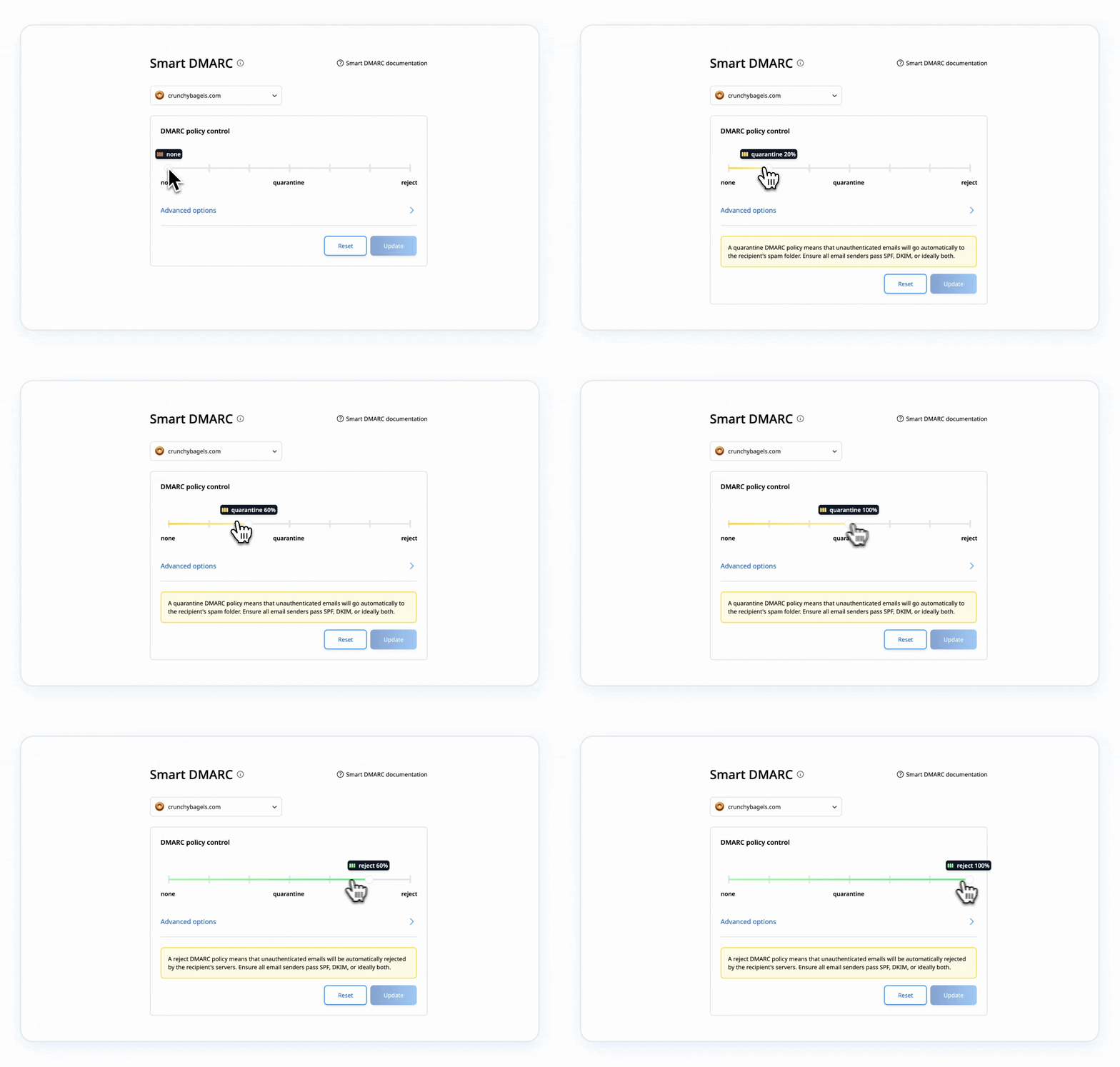
Try the agent on your own domains or review Microsoft's sender requirements.
Authentication is one part of email security. Keep message filtering, account security, and incident response controls in place as well.
Questions readers ask
Frequently Asked Questions (FAQ)
What are the biggest email security threats in 2025?
Phishing, spoofing, and AI-driven scams are surging, with 94% of businesses hit in 2024 and $84 million in losses. These threats flood inboxes with spam (90% of emails) and erode trust, making strong, layered cybersecurity critical for protecting your company.
Why are Google, Yahoo, and Microsoft enforcing new requirements since 2024?
Google and Yahoo set strict SPF, DKIM, and DMARC standards in 2024 to fight phishing and spoofing. Microsoft’s 2025 rules follow suit, ensuring only verified emails reach inboxes, boosting security industry-wide.
Who needs to follow Microsoft’s 2025 rules?
High-volume senders (over 5,000 daily emails to Outlook users) must comply, but all businesses benefit from adopting these standards to protect against scams and improve deliverability.
What happens without DMARC compliance?
Emails could hit spam folders or be blocked, damaging your sender reputation and reducing deliverability, especially with Microsoft’s May 2025 enforcement.
SPF:
Lists authorized email servers for your domain.- DKIM: Adds a digital signature to prove email authenticity.- DMARC: Sets rules (none, quarantine, reject) for emails failing SPF/DKIM, protecting against spoofing.
What other best practices improve email security?
Use valid “From” addresses, include clear unsubscribe links, clean invalid email lists, and ensure recipients consent to your messages to reduce spam complaints and enhance trust.
Why clean email lists?
Removing inactive or invalid addresses cuts bounces, lowers spam flags, saves costs, and keeps your emails landing in inboxes.
What’s the best practice for unsubscribe links?
A visible, one-click link in bulk or marketing emails that lets recipients opt out easily, meeting industry standards and user expectations.
Do small senders need to comply?
While only high-volume senders face Microsoft’s mandate, all businesses should adopt SPF, DKIM, and DMARC to stay secure and align with industry trends.

Written by
Samuel ChenardCEO & Co-Founder, Palisade
Samuel Chenard is the CEO and co-founder of Palisade, agentic DMARC software for IT teams and MSPs, from one domain to thousands.
More from Samuel →