
ONTARIO RESEARCH / CANADA 2026

Ontario email-authentication benchmark 2026

Across 556 observed Ontario organization domains, 74.3% published valid DMARC. This is a sourced benchmark dominated by the official municipal directory—not a representative sample of every Ontario organization.

WHY THIS MATTERSWhen a forged public-service message fails aligned authentication, a missing or monitoring-only policy leaves receivers without the municipality’s requested quarantine or rejection action. This DNS observation is not evidence that a false notice was sent or delivered.

74.3%

DMARC adoption

413 of 556

60.5%

Enforcement among DMARC publishers

250 of 413

21.8%

DMARC publishers without aggregate reporting

90 of 413

4.1%

SPF publishers with recursive lookup failures

21 of 508

WHY THIS MATTERS

What is the risk when DMARC is missing?

Municipal and public-service domains carry unusual trust: residents expect them to send tax, permit, payment, emergency and service notices. A missing or monitoring-only policy leaves less protection at participating receivers when a forged message fails aligned authentication.

Learn how DMARC evaluates a message →

01 / DOMAIN IDENTITY

The visible From address can be forged

An attacker can send a message that displays the organization's exact domain in the From line. Without a valid DMARC record, participating receivers have no DMARC handling request from that domain owner when aligned SPF and DKIM fail.

02 / PRACTICAL HARM

Residents can be sent convincing false notices

A forged message appearing to come from a municipality or public body could redirect a payment, steal a portal password, or circulate a false service or emergency notice. The DNS measurement does not show that any such message was sent or delivered.

THREE DIFFERENT DNS STATES

No valid DMARC
No domain-owner DMARC policy. Aggregate reports cannot be requested through that record.
DMARC at p=none
Monitoring only. Reports may be collected, but the owner requests no DMARC-based quarantine or rejection.
p=quarantine or reject
The owner asks receivers to act on messages that fail aligned authentication. Receiver behavior can still vary.

Risk, not incident evidence: this DNS state does not prove spoofing, fraud, compromise or weak internal controls. DMARC also does not stop lookalike domains, abuse of a compromised legitimate account or every phishing technique.

FOUR DISTINCT FINDINGS

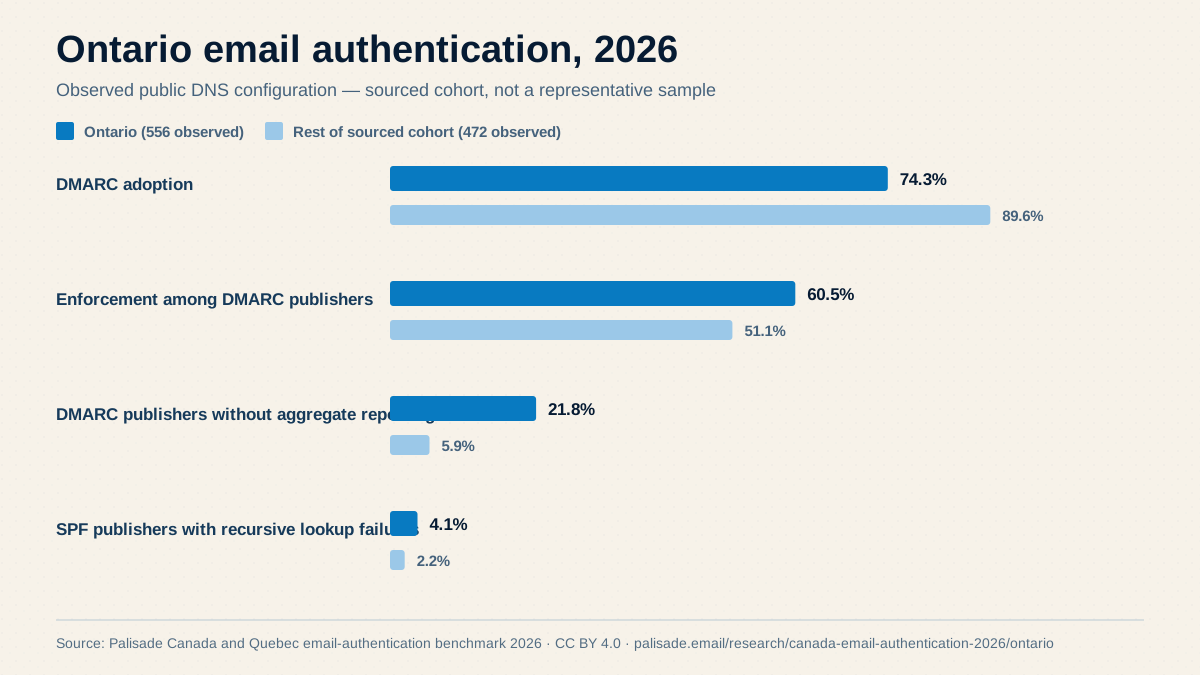
Ontario publishes DMARC less often, but its publishers enforce more often

The reporting gap moves in the other direction: 90 of 413 Ontario DMARC publishers had no aggregate-reporting address, compared with 25 of 423 in the rest of the sourced Canadian cohort. These comparisons are descriptive and reflect a materially different cohort mix.

DMARC adoption

Every percentage shows its measured denominator

Ontario
74.3% (413/556)
Rest of cohort
89.6% (423/472)

Enforcement among DMARC publishers

Every percentage shows its measured denominator

Ontario
60.5% (250/413)
Rest of cohort
51.1% (216/423)

DMARC publishers without aggregate reporting

Every percentage shows its measured denominator

Ontario
21.8% (90/413)
Rest of cohort
5.9% (25/423)

SPF publishers with recursive lookup failures

Every percentage shows its measured denominator

Ontario
4.1% (21/508)
Rest of cohort
2.2% (9/418)

“Rest of cohort” is calculated by subtracting the Ontario numerators and denominators from the frozen national publication. It contains 472 observed domains.

WHAT THE COHORT CONTAINS

The municipal slice makes this useful—and limits the claim

439 of 556 Ontario observations (79.0%) are municipalities from Ontario's official directory. The remaining rows come from the Canada report's sourced public-institution, education, health-system and listed-company inputs.

That coverage supports a strong Ontario municipal-operations story. It does not support claims about every Ontario business, every sending domain, incident rates, compromise, delivery performance or the quality of internal controls.

Review the official Ontario source

CITE & REUSE

Every comparison is downloadable

The Ontario slice, rest-of-cohort comparator and publication-gate evidence are released under CC BY 4.0. The source report remains the canonical national study.

Suggested citation

Palisade. “Ontario email-authentication benchmark 2026.” 2026-08-16. https://www.palisade.email/research/canada-email-authentication-2026/ontario