What is DANE and does your email need it?
 ChatGPT
 Claude
 Gemini
 Perplexity
 Grok
GrokIn brief
DANE uses DNSSEC-signed TLSA records to authenticate SMTP TLS. Learn when email domains need DANE, how it works, and how to validate it safely.

DANE, short for DNS-Based Authentication of Named Entities, lets a receiving email domain publish DNSSEC-protected TLSA records that tell SMTP senders how to authenticate its mail servers. For SMTP, RFC 7672 defines how senders use those records to require authenticated TLS for delivery when usable DANE TLSA records exist. Your email domain needs DANE when you can operate DNSSEC correctly and want transport protection that does not rely only on public certificate authorities.
At a glance
Quick takeaways
- DANE for SMTP uses TLSA DNS records and DNSSEC validation to authenticate a receiving mail server's TLS certificate or public key.
- RFC 6698 defines the TLSA record type, while RFC 7672 defines its SMTP use.
- A TLSA record without a DNSSEC-validated chain is not usable as a DANE trust signal.
- SMTP DANE records apply to each destination MX host, normally at
_25._tcp.. - DANE protects the SMTP transport path. SPF, DKIM, and DMARC authenticate sending domains and address a different problem.
- MTA-STS also supports authenticated SMTP transport, but it uses an HTTPS policy and the web PKI instead of DNSSEC.
Who is affected?
DANE affects domains that receive SMTP mail on infrastructure they control or can configure through a mail provider. The receiving domain publishes TLSA records for the MX hosts that accept mail, and sending systems that support SMTP DANE can validate those records before delivery.
The core dependency is DNSSEC. RFC 7671 explains that DANE relies on DNSSEC to authenticate TLSA data. A record that is merely visible in public DNS does not provide DANE authentication. The sender needs a DNSSEC-validated answer for the TLSA lookup and the DNS records that establish the relevant DNSSEC chain.
This makes DANE a poor fit when you cannot safely manage DNSSEC, do not control the MX hosts, or cannot coordinate certificate and DNS record changes with the mail service that presents the TLS certificate. It can be a good fit for domains with stable inbound mail infrastructure, DNSSEC operational ownership, and a need to make downgrade-resistant SMTP TLS available to supporting senders.
DANE does not require every sender on the internet to implement it. A sender that does not support SMTP DANE will not obtain DANE authentication from your TLSA records. That is why a broader email transport security guide should consider both protocol support and your actual receiving environment.
What are the requirements?
DNSSEC must authenticate the TLSA lookup
A DANE client uses DNSSEC validation to decide whether TLSA data is secure and usable. DNSSEC is not an optional hardening layer around SMTP DANE. It is the trust mechanism that prevents an active network attacker from replacing or suppressing the TLSA answer.
Before publishing TLSA records, confirm that the zone is signed, its delegation is correct, and validating resolvers can obtain secure answers. A DNSSEC failure can have delivery consequences for DANE-aware senders, so treat DNSSEC changes as production mail changes.
The TLSA record binds a TLS service to certificate data
RFC 6698 defines a TLSA record as four fields: certificate usage, selector, matching type, and certificate association data. The first three fields state how to evaluate the association data. The last field contains the certificate or public-key material, or a digest of it, selected by those fields.
For SMTP, the TLSA owner name is built from the TCP port and the destination MX hostname. This structural example is illustrative only. Do not publish another organization's certificate association data. Generate the actual value from the certificate or key used by your own MX host.
_25._tcp.mail.yourdomain.com. IN TLSA 3 1 1 <SHA-256-subject-public-key-info-digest>A 3 1 1 TLSA record uses DANE-EE certificate usage, the SubjectPublicKeyInfo selector, and a SHA-256 matching type. RFC 7672 describes DANE-EE as the expected SMTP deployment profile. The correct value still depends on the certificate or public key your receiving mail server presents.
SMTP delivery uses the MX hostname, not only the recipient domain
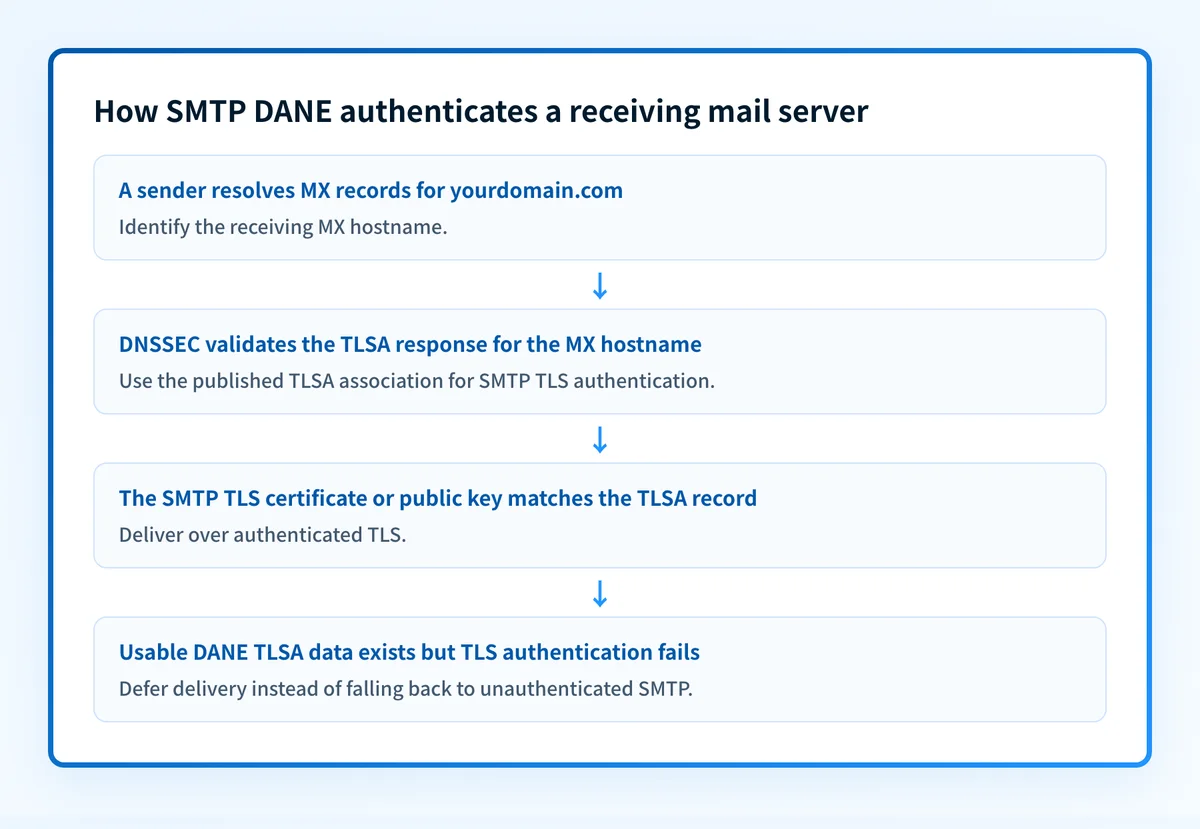
SMTP delivery first follows the recipient domain's MX records. RFC 7672 applies TLSA lookups to the resulting SMTP destination hostnames. If yourdomain.com has several MX hosts, each host that can receive mail needs TLSA data that matches the TLS service it presents.
A TLSA record at _25._tcp.yourdomain.com does not automatically cover mail.yourdomain.com when that is the MX hostname. Review the published MX answers and build the TLSA name from each actual destination host.
This is also why an MX change, certificate renewal, or load-balancer change needs DANE review. A valid TLSA record for one host does not authenticate another host with a different certificate or public key.
The sender authenticates TLS when usable DANE records exist
SMTP has historically used opportunistic TLS. A sender can use STARTTLS when offered, but traditional opportunistic TLS does not by itself stop a network attacker from stripping STARTTLS or presenting an untrusted certificate.
RFC 7672 defines how a DANE-aware SMTP client uses DNSSEC-authenticated TLSA records to obtain authenticated TLS. When the client has usable DANE TLSA records for the destination, it must not fall back to unauthenticated delivery merely because TLS authentication fails. Delivery can defer while the sender retries according to its queue policy.
A stale or incorrect TLSA record can interrupt inbound mail from DANE-aware senders. Stage certificate and TLSA changes together, and keep a tested rollback path.
When does the requirement take effect?
DANE is an IETF protocol standard, not a single mailbox-provider deadline. RFC 6698 was published in August 2012 and defines TLSA records. RFC 7671, published in October 2015, gives DANE operational guidance. RFC 7672, published in October 2015, defines SMTP transport security using DANE.
These are final RFCs, not drafts. They do not impose a universal date by which every email domain must publish TLSA records, and they do not guarantee that every sending platform will use them. Your effective date is operational: DANE begins to affect delivery when a supporting sender reaches one of your DNSSEC-validated MX destinations and finds usable TLSA records.
Do not turn uneven implementation support into a protocol claim. Test the sending paths that matter to your organization, and retain MTA-STS or other transport controls where they fit your requirements.
How do I implement the requirement?
1. Inventory your receiving MX hosts
Query the MX records for the recipient domain and list every hostname that can receive SMTP mail. Include priority changes, regional hosts, and failover hosts.
Use DNS records for business email as a reference for the roles of MX, TXT, and other email DNS records. DANE records are tied to the MX destination hostname, not to a vague idea of the email domain.
2. Establish and validate DNSSEC
Enable DNSSEC with the DNS operator responsible for the zone and confirm the parent delegation is correct. Validate the chain with a DNSSEC-aware resolver before relying on TLSA data.
A public lookup can help inspect published DNS. It cannot prove that every production sender validates the chain, that your mail host is presenting the intended certificate, or that a particular receiver will accept delivery.
3. Obtain the certificate association data from the receiving service
Identify the certificate or public key that each MX host presents for SMTP on TCP port 25. Decide the TLSA usage, selector, and matching type based on the applicable RFC profile and your service's certificate lifecycle.
Coordinate with a managed mail provider before publishing records. Do not derive values from a browser certificate for a web hostname and assume they apply to SMTP. The SMTP listener may use a different certificate or key.
4. Publish TLSA records for each destination host
Publish a DNSSEC-signed TLSA record at _25._tcp. for every relevant MX hostname. Allow DNS propagation and DNSSEC validation to complete before changing the certificate or routing production mail to a new host.
When rotating keys, publish association data that supports the planned transition before withdrawing the old record. The exact overlap strategy depends on the certificate material and record choices you use.
5. Keep transport security separate from sender authentication
DANE protects the connection between SMTP servers. It does not tell a recipient whether the visible From domain is authorized to send the message.
Maintain SPF, DKIM, and DMARC alongside transport controls. DMARC's role in email security is different: it evaluates identifier alignment and policy for a message's From domain.
How do I validate compliance?
Validate DANE at four layers.
- DNS: inspect MX, TLSA, DNSKEY, DS, and DNSSEC validation results through authoritative DNS and at least one validating public resolver. Confirm each TLSA owner name maps to a real MX destination.
- Vendor or host: confirm with the mail-hosting provider which SMTP certificate and public key each receiving host currently presents. A provider dashboard can help, but it is not message-path evidence.
- Message and TLS: test SMTP delivery from a DANE-capable sending path to the exact production MX host. Confirm that the certificate presented during SMTP TLS matches the published, DNSSEC-validated TLSA association.
- Ongoing DMARC evidence: use aggregate reports to understand who sends mail using your domain. DMARC reports do not validate inbound DANE, but they help keep sender authentication work separate from transport-security work.
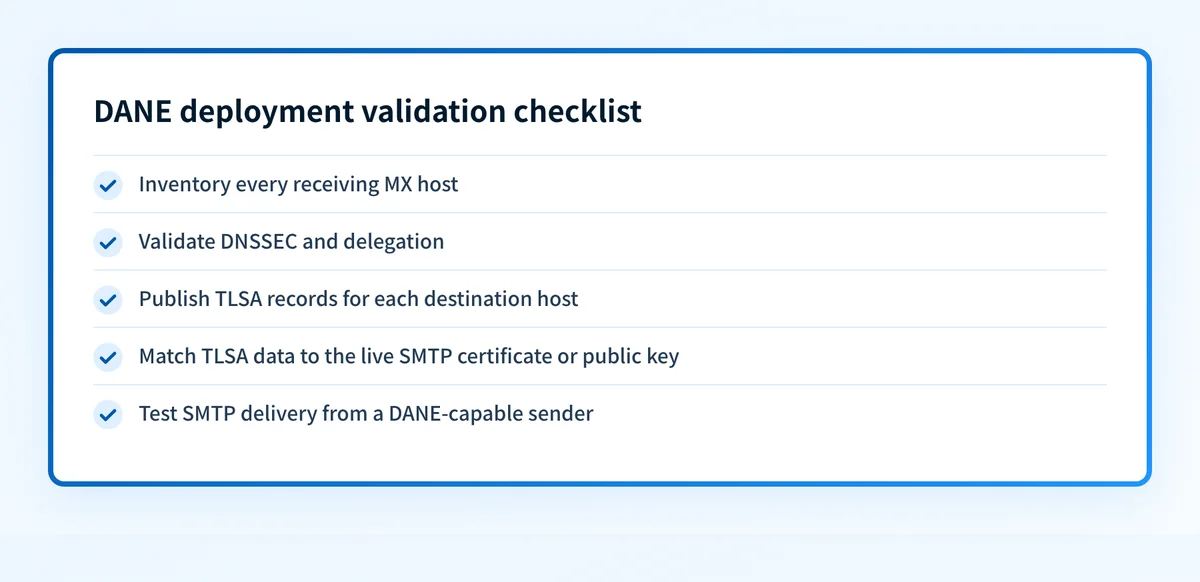
Use Palisade's DNS lookup tool to inspect public DNS records for a domain before making changes. A public DNS check does not prove the production SMTP certificate, continuous DNSSEC health, a sender's DANE implementation, or future delivery decisions.
Inspect the DNS records behind your DANE deployment
Start with the MX hosts and published DNS records for the receiving domain. Compare every TLSA record with the SMTP service and certificate your mail provider confirms.
Palisade is agentic DMARC software that analyzes DMARC aggregate-report data, identifies sending sources and authentication or alignment issues, and proposes prioritized remediation work for human review. It can help with the ongoing sender-authentication work around your domains, but it does not change a DANE policy, validate every SMTP TLS connection, or control a receiving provider's delivery decision.
Evidence
Sources and further reading
- RFC 6698: The DNS-Based Authentication of Named Entities (DANE) Transport Layer Security (TLS) Protocol: TLSA
- RFC 7671: The DNS-Based Authentication of Named Entities (DANE) Protocol: Updates and Operational Guidance
- RFC 7672: SMTP Security via Opportunistic DANE Transport Layer Security (TLS)
- RFC 8461: SMTP MTA Strict Transport Security (MTA-STS)
Questions readers ask
Frequently asked questions
Does DANE require DNSSEC?
Yes. DANE relies on DNSSEC validation to authenticate TLSA records. Without a secure DNSSEC result, a TLSA record cannot provide the DANE trust signal that SMTP DANE needs.
Is DANE the same as MTA-STS?
No. Both can improve SMTP transport security, but DANE uses DNSSEC-signed TLSA records to authenticate the receiving service. MTA-STS uses a DNS signal, an HTTPS policy file, and the web public-key infrastructure.
Does DANE replace DMARC?
No. DANE authenticates the SMTP transport connection to a receiving mail server. DMARC uses SPF and DKIM results to evaluate whether mail aligns with the message's visible From domain.
Do I need one TLSA record for every MX host?
Yes. SMTP DANE checks TLSA records for the actual MX destination hostname. Each MX host that receives mail needs TLSA data appropriate for the SMTP certificate or public key it presents.
Can a DNS lookup prove that DANE is working for all senders?
No. A DNS lookup can inspect public MX, TLSA, and related DNS records. It cannot prove that every sender implements DANE, that the live SMTP service presents matching certificate material, or that future delivery will succeed.

Written by
Ian BussieresCTO & Co-Founder, Palisade
Ian Bussieres is the CTO and co-founder of Palisade, agentic DMARC software for IT teams and MSPs.
More from Ian →