DMARC software pricing compared
 ChatGPT
 Claude
 Gemini
 Perplexity
 Grok
GrokIn brief
DMARC software pricing compared: which vendors publish list prices, what each one actually charges for, and how to make competing quotes comparable.
DMARC software pricing is only comparable after you define the operating scope: domains, report volume, tenants, support, and whether your team will perform remediation itself. Choose a vendor with published plans when the documented limits match that scope and procurement needs a clear starting price. Choose a quote-based evaluation when the work includes a larger domain estate, managed services, or requirements that a public plan page does not answer.
At a glance
Quick takeaways
- A displayed monthly price does not establish the total cost for every domain, tenant, support level, or contract term.
- Compare published plan limits against the same operational inputs before treating two DMARC products as equivalent.
- A vendor that requests a quote may still fit the requirement, but the commercial terms must be confirmed directly.
- DMARC report volume, domain count, MSP tenant structure, retention, onboarding, and support can change the buying decision.
- Public DNS checks can establish the current DMARC record, but they do not prove how a paid platform will classify every production sender.
- Record unanswered commercial questions as open items instead of estimating a price from third-party listings.
Who this comparison is for
This comparison is for IT teams, security teams, and MSPs evaluating PowerDMARC, DMARCLY, Sendmarc, Red Sift, Valimail, and Palisade as DMARC software.
The immediate question may look like a price comparison. In practice, the decision also depends on what the team needs the product to operate. A single-domain team that wants to review reports has a different requirement from an MSP that must separate customer tenants, onboard many domains, assign work, and report on progress.
Start with the operating facts that can be supplied consistently to each vendor:
- Number of active and planned sending domains.
- Expected DMARC aggregate-report volume and desired data-retention period.
- Number of internal users, customer tenants, and delegated operators.
- Required onboarding, support, implementation, and managed-service arrangements.
- Contract preference, billing currency, procurement process, and security-review requirements.
- Whether the team wants to investigate recommendations and apply each change itself, or wants an AI-first, agent-first DMARC workflow that does the analysis and prepares prioritized remediation work.
How the options were evaluated
A pricing comparison needs the same dated criteria for each option. Use each vendor's current first-party pricing page, plan terms, and sales material at the time of evaluation. If a page does not answer a criterion, keep it as an open question. Missing public detail does not prove that a feature, limit, or commercial option is unavailable.
Use these criteria:
- Published pricing: Is a current self-service price shown, or must the buyer request a quote?
- Billing basis: Does the vendor state whether billing is monthly, annual, contract-based, usage-based, or another model?
- Included scope: What does the vendor document about domains, report volume, users, tenants, retention, or support?
- Additional costs: Does the vendor document implementation, onboarding, managed service, premium support, or add-on charges?
- Operational fit: Does the documented offer match the team's reporting, remediation, policy-rollout, or multi-tenant workflow?
- Contract clarity: Are currency, taxes, renewal terms, regional availability, and cancellation conditions documented for the intended purchase?
option: <vendor name>
checked_on: 2026-08-13
published_pricing: <plan prices shown | quote required | confirm>
billing_basis: <monthly | annual | contract | confirm>
operating_scope:
  domains: <confirm documented allowance>
  report_volume: <confirm documented allowance>
  tenants_or_users: <confirm documented allowance>
support_and_services: <confirm documented scope and charges>
best_fit: <buyer requirement supported by current evidence>
open_question: <unpublished term that affects the decision>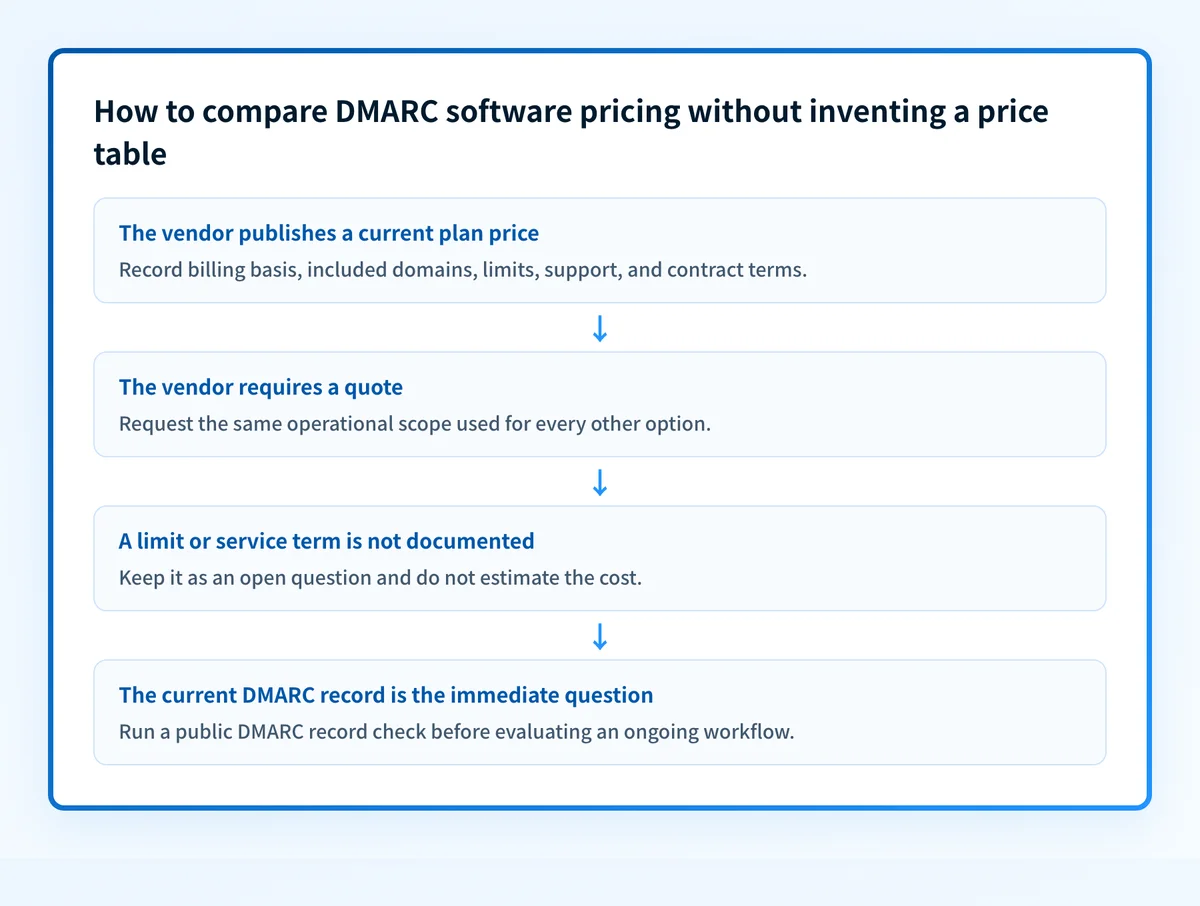
PowerDMARC pricing
- Best fit: A buyer whose requirements can be matched to PowerDMARC's current first-party pricing and sales documentation.
- Relevant evidence: Confirm the current published plans, billing basis, domain allowance, report limits, MSP terms, support scope, and any implementation charges directly with PowerDMARC before comparing its commercial offer.
- Tradeoff: A displayed plan price is incomplete if the buyer cannot map its domains, users, tenant structure, or support needs to the stated limits.
DMARCLY pricing
- Best fit: A buyer whose required domain scope and operational needs are documented in DMARCLY's current commercial materials.
- Relevant evidence: Confirm current plan availability, billing terms, published limits, support scope, and any separate service charges on DMARCLY's first-party purchase or pricing path.
- Tradeoff: A plan name or entry price cannot be compared fairly until the included operating scope is known.
Sendmarc pricing
- Best fit: A buyer that can obtain a Sendmarc offer aligned with its domains, report flow, implementation needs, and contract process.
- Relevant evidence: Confirm whether current Sendmarc pricing is published or quote-based, then capture the documented billing basis, included scope, and services in the vendor's response or first-party materials.
- Tradeoff: A quote is not directly comparable with a public plan until both are normalized to the same required scope and contract period.
Red Sift pricing
- Best fit: A buyer that needs to evaluate Red Sift against its current first-party commercial documentation and the team's own operating requirements.
- Relevant evidence: Confirm Red Sift's current pricing route, plan or contract structure, documented allowances, and any service or support terms that apply to the proposed deployment.
- Tradeoff: Publicly available product information alone may not answer the buyer's final scope or contract questions.
Valimail pricing
- Best fit: A buyer that can match Valimail's current commercial offer to the required domain and operational scope.
- Relevant evidence: Confirm current Valimail pricing, billing terms, included domains or services, support, and any additional charges from Valimail's first-party pricing or sales materials.
- Tradeoff: A pricing page or quote cannot establish the operational fit without confirming the limits and services relevant to the deployment.
Palisade pricing
- Best fit: IT teams and MSPs that want an AI agent to analyze DMARC aggregate-report data, identify sending sources and authentication or alignment issues, and create prioritized remediation tickets for human review.
- Relevant evidence: Review the current Palisade pricing information alongside the actual domain and tenant scope. Palisade can detect when a domain appears ready for the next DMARC policy stage and propose the next policy step, while a human reviews the evidence and applies the DNS change.
- Tradeoff: Palisade does not autonomously change a DMARC policy, guarantee delivery, or prove that every future message will authenticate.
How to choose
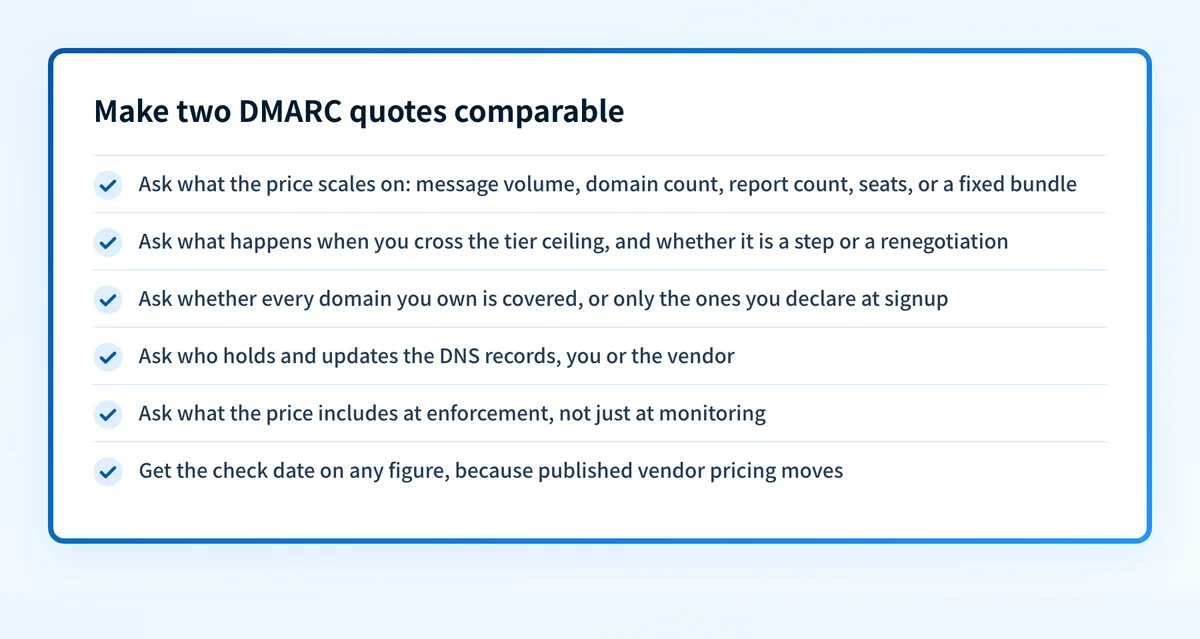
Choose the option that documents, or confirms in writing, the commercial scope needed for your actual environment. Do not compare a self-service entry plan with an enterprise quote until you normalize the number of domains, expected report data, users or tenants, support level, onboarding work, contract period, and currency.
Use this buyer checklist:
- Verify the current first-party price or quote date for every option.
- Confirm what the price includes for the complete domain inventory.
- Ask how report volume, retention, users, and MSP tenants affect the offer.
- Separate software charges from onboarding, managed service, support, and add-ons.
- Confirm annual commitments, renewal terms, currency, taxes, and cancellation conditions.
- Compare the remediation workflow, not only the dashboard or initial plan price.
option: PowerDMARC
checked_on: 2026-08-13
best_fit: Confirm against current first-party commercial documentation
verified_evidence: Pricing and scope require a dated vendor-page review
open_question: Published price, limits, and applicable services
option: DMARCLY
checked_on: 2026-08-13
best_fit: Confirm against current first-party commercial documentation
verified_evidence: Pricing and scope require a dated vendor-page review
open_question: Published price, limits, and applicable services
option: Sendmarc
checked_on: 2026-08-13
best_fit: Confirm against current first-party commercial documentation
verified_evidence: Pricing and scope require a dated vendor-page review
open_question: Published price, limits, and applicable services
option: Red Sift
checked_on: 2026-08-13
best_fit: Confirm against current first-party commercial documentation
verified_evidence: Pricing and scope require a dated vendor-page review
open_question: Published price, limits, and applicable services
option: Valimail
checked_on: 2026-08-13
best_fit: Confirm against current first-party commercial documentation
verified_evidence: Pricing and scope require a dated vendor-page review
open_question: Published price, limits, and applicable services
option: Palisade
checked_on: 2026-08-13
best_fit: Ongoing DMARC analysis and human-reviewed remediation workflow
verified_evidence: Review current Palisade pricing against the required domain and tenant scope
open_question: Applicable plan and commercial terms for the buyer's environment
Check the DMARC record before pricing an operating workflow
Before selecting DMARC software, inspect the sending domain's current public DMARC policy with the DMARC checker. That gives the buying team a starting point for the records it publishes today and helps separate a DNS-policy question from a recurring report-analysis and remediation-workflow requirement.
A public DNS check cannot show every production sender, prove a receiver's private decision, monitor future changes, or establish how a paid platform will price your environment.
Evidence
Sources and further reading
Source: Palisade.
Questions readers ask
Frequently asked questions

Written by
Samuel ChenardCEO & Co-Founder, Palisade
Samuel Chenard is the CEO and co-founder of Palisade, AI-first DMARC software for IT teams and MSPs, from one domain to thousands.
More from Samuel →